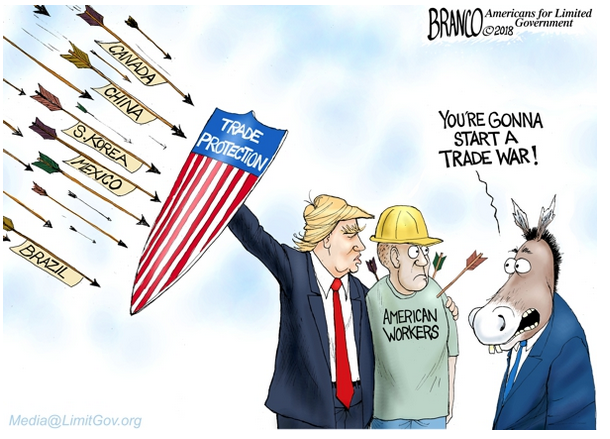
Trump is pursuing freer fairer trade policies

  • China reneged on trade– so pansies in the economic press and Wall Street crap their drawers and cry
  • China has a weak hand
  • Stay the course

Why China left Trump with little choice but to slap on the 25 percent tariffs on $200 billion of goods 

By Robert Romano

Just when it appeared that a new trade agreement with China was being finalized last week, Beijing abruptly attempted to change all the terms of the deal and walk back prior concessions that had been made to head off President Donald Trump’s threat to increase tariffs from 10 percent to 25 percent on $200 billion of goods.

The changes had arrived on May 3 late in the evening and blew up months’ worth of negotiations.

According to Reuters’ David Lawder, Jeff Mason and Michael Martina, “In each of the seven chapters of the draft trade deal, China had deleted its commitments to change laws to resolve core complaints that caused the United States to launch a trade war: Theft of U.S. intellectual property and trade secrets; forced technology transfers; competition policy; access to financial services; and currency manipulation.”

It was an unacceptable situation. China was reneging on the deal. Trump had already delayed the 25 percent tariffs in January to give negotiations a chance to make a breakthrough. Then, on the eve of concluding the agreement, Beijing wanted to do a complete 180 on everything that had already been discussed.

Instantaneously, and in response, on May 5, President Trump said that the new tariffs were going into effect, giving May 10 as a hard deadline, which has now passed. The tariffs went up at midnight.

China’s erratic behavior in the past week necessitated Trump’s tariff threat, if for no other reason than to get the negotiations back on track. It could be argued that the only reason for the negotiations in the first place was because of the imminent tariffs.

Now, we can only surmise the apparent concessions by China were merely a delaying tactic, intended to test out how committed Trump was to the tariffs. And now China knows President Trump means business.

Which, it’s time to get tough. Since China entered the World Trade Organization in 2001, U.S. manufacturing market share has dropped from 13.4 percent to 7.5 percent in 2017, according to World Bank data. China has risen from 5.3 percent to 16.6 percent in 2017, although their percent of global manufacturing market share has peaked in 2015 at 18.8 percent.

During that time, the U.S. economy has not grown above 4 percent since 2000, and not above 3 percent in 2005 on an annual basis.

The trade in goods deficit with China hit a record high in 2018 at $419.1 billion according to the U.S. Census Bureau. And that was with President Trump’s 10 percent tariffs on $200 billion of Chinese goods that came atop a 25 percent tariff on $50 billion of hi-tech goods.

Fueling the shift in production has been a competitive devaluation of China’s currency, the yuan. From 2014 alone after a period of revaluation, Beijing shifted from being worth 6.05 per dollar to about 6.8 today, a 12.6 percent devaluation.

China has a lot more to lose in a trade war than the U.S., too, according to data by the U.S. Trade Representative. China’s $539.5 billion of goods exports to the U.S. comprised almost 4.1 percent of its $13.28 trillion Gross Domestic Product in 2018 and about 22.5 percent of its $2.4 trillion of goods exports. In contrast, American goods exports to China were $120.3 billion, comprising 0.58 percent of the 2018 annual GDP of $20.5 trillion, and comparatively 7.2 percent of its $1.66 trillion of goods exports.

From 2000 to 2016, the U.S. lost nearly 5 million manufacturing jobs. There was some recovery after the financial crisis, and in addition, 470,000 manufacturing jobs have been created since President Trump came into office in 2017.

Labor participation among working age adults has dropped significantly through 2016, accounting for about 9 million people who would have been participating in the economy had labor participation remained the same. Since President Trump took office, that number is down to about 6 million or so as working age labor participation has increased, thanks in part to Trump’s new trade policies but also tax cuts and deregulation to make the U.S. more competitive globally.

None of the bad things that were supposed to happen because of the tariffs have come to pass. The economy grew at 2.9 percent in 2018. It has accelerated to 3.2 percent in the first quarter.

Unemployment is at a 49-year low at 3.6 in April.

Inflation is normal at about 1.9 percent the past 12 months as of this writing.

The negotiations are still ongoing, and a deal may still be had, but even if that does not happen, the world is not ending. The sun still rose today.

The point is, there is most certainly a case to be made for the President’s tariff stance. If anything, the question about the new tariff is not whether it is justified, but whether it is big enough?

Robert Romano is the Vice President of Public Policy at Americans for Limited Government.

Related reading:

How the US Can Solve the Current Trade Tariff Impasse With China

(spoiler alert: stay the course)

And oh by the way farmer friends — where is China getting what it needs? And those other suppliers – where are they unable to sell that you can’t supply?  No one can invent crop land so quick. The market is fungible and China can’t cut back and not have that be an incentive on them to get back to the table.

Posted in UNCATEGORIZED | Comments Off on Trump is pursuing freer fairer trade policies

MAKE MAXINE WATERS’ TAX RETURNS PUBLIC…NOW!

  • And the Speaker of the House she shares a brain with
  • How do they get away with this hypocrisy? Oh, we forgot . . .
  • AP touting ‘heroic’ Maxine

– WATERS’ ROLE’ AS A ‘MODEL’ FOR THE BLACK COMMUNITY DOES A TERRIBLE DISSERVICE TO THAT COMMUNITY

– IF TRUMP’S TAX RETURNS CAN BE MADE PUBLIC, WHY NOT EVERY MEMBER OF CONGRESS’S (We’re betting Maxine’s would really be ‘revealing’!)

Maxine Waters a model for many outspoken freshman Democrats
By LAURIE KELLMAN, ASSOCIATED PRESS

WASHINGTON (AP) — She’s been called “Kerosene Maxine” and gaveled off the House floor for accusing Republican men of badgering women. She dismissed President Donald Trump and his allies as thugs and predicted his impeachment before he was sworn into office.

No one, Maxine Waters once observed, should be surprised by her. But after nearly three decades in Congress, the 80-year-old California lawmaker is in an eye-opening role as the highest-ranking African American woman in the country. She’s wielding the gavel of the bank-regulating Financial Services Committee with the power to investigate Trump where some say it counts most: his business dealings.


Posted in UNCATEGORIZED | Comments Off on MAKE MAXINE WATERS’ TAX RETURNS PUBLIC…NOW!

What P T Barnum meant to say . . .

THE NINTH “WONDER OF THE WORLD” SEE IT NOW!

6 FOOT TALL MAN-EATING CHICKEN*

Only $10, Proceeds Go To Democratic National Committee

And here it is:

This is why P.T. Barnum meant to say “There’s a Democrat Voter Born Every Minute!”

—————————-

One more reason Steve Cohen is a runner-up to Maxine Waters and “Pencil-Neck” Schiff every year in the “Dumbest Clown in Congress”!

During a 2018 open congressional hearing of FBI agent Peter Strzok, Cohen said, “If I could give you a Purple Heart, I would… This has been an attack on you and a way to attack Mr. Mueller and the investigation that is to get at Russian collusion involved in our election.” (Veteran groups criticized his comment, as the Purple Heart is reserved of recognizing soldiers wounded in combat! Cohen apologized for his comments, saying “I regret mentioning the Purple Heart medal at yesterday’s hearing. My intent was to speak metaphorically to make a broader point about attacks against the FBI and Special Counsel Mueller’s investigation into a Russian attack on our country.” )

*One of the most incredible shows the world has ever seen was at the American Museum in New York in 1856. This museum contained a vast array of curiosities and freaks, but the most amazing highlight was the 6-Foot-Tall Man Eating Chicken.

Such a creature sounds impossible and horrific, but it was one of the key attractions of the museum. People would stand in line for a brief glimpse of such a beast. And who can blame them? After paying a few pennies for admission, they’d be ushered into a room, the curtains would be pulled back, and the stunning attraction would appear before them, just as described …

A tall man, seated at a table, gnawing on some chicken wings.
The greatest show on earth

Whatever else you say about P.T. Barnum, the mind behind the Man Eating Chicken, the fellow knew how to woo a crowd. While people didn’t always get exactly what they expected, they’d certainly be entertained.       DLH

Related reading here

Posted in UNCATEGORIZED | Comments Off on What P T Barnum meant to say . . .

The chaplain of one-world government is at it again

  • Proposes/endorses The InterState Highway to Serfdom
  • The Pope’s pathetic blandishments about nations; the demurral that this does not imply portend one-world government notwithstanding
  • This is about loss of freedoms contra Christian ethics
  • Cooperation does not require one-world government

Via Lifesitenews.com  (excerpt)

Pope Francis calls for new ‘supranational’ authorities to enforce UN goals

Featured Image
Pope Francis addresses the General Assembly during his visit to the United Nations headquarters in New York, U.S., Sept. 25, 2015. Luiz Rampelotto/Pacific Press/LightRocket via Getty Images

ROME, May 2, 2019 (LifeSiteNews) — Pope Francis made a strong new push for globalism on Thursday, calling for a supranational, legally constituted body to enforce United Nations Sustainable Development Goals and implement “climate change” policies. 

Speaking to members of the Pontifical Academy of Social Sciences in the Vatican’s Apostolic Palace, the Pope said: “When a supranational common good is clearly identified, there is need for a special legally constituted authority capable of facilitating its implementation.” 

“Think of the great contemporary challenges of climate change, new slavery and peace,” he told members of the Pontifical Academy, who are meeting this week at the Vatican for a plenary session themed: “Nation, State, Nation-State.” 

Featured speakers at the May 1-3 plenary include German Cardinal Walter Kasper, who spoke on: “Peace Stemming from Justice. Theological Reflections Between Men, Communities and Nations”; Archbishop Roland Minnerath of Dijon, France, who delivered the opening talk on day two, themed: “Nation, State, Nation-State and the Doctrine of the Catholic Church”; and German climatologist and founding director of the Potsdam Institute for Climate Impact, Hans Joachim Schellnhuber, who addressed the Pontifical Academy on “The State of the World.”

In his address to the academy, the Pope said that while “the principle of subsidiarity” requires that “individual nations must be given the power to operate as far as they can reach,” nonetheless “groups of neighboring nations — as is already the case — can strengthen their cooperation by attributing the exercise of certain functions and services to intergovernmental institutions that manage their common interests.” 

The thrust of the Pope’s remarks, however, focused on growing trends toward nationalism which he said threatens migrants, the “universal common good” and the power of the United Nations and other transnational bodies to implement the Sustainable Development Goal agenda. 

The Church “has always exhorted men to love their own people and homeland,” he said. “At the same time,” he added, “the Church has warned persons, peoples and governments about deviations from this attachment when it is about excluding and hating others, when it becomes conflictual nationalism that builds walls, indeed even racism or anti-Semitism.”

“The Church observes with concern the re-emergence, almost everywhere in the world, of aggressive currents towards foreigners, especially immigrants, as well as that growing nationalism which neglects the common good,” Pope Francis continued.

“There is a risk of compromising already established forms of international cooperation, undermining the aims of international organizations as a space for dialogue and meeting for all countries on a level of mutual respect, and hindering the achievement of the sustainable development goals unanimously approved by the General Assembly of the United Nations on 25 September 2015,” he told members of the Pontifical Academy of Social Sciences.

SDGs: eliminating poverty or children?

Many are concerned that some of the Sustainable Development Goals (SDGs), while billed as aimed at eliminating poverty, are really about eliminating children. “Reproductive health services” for example, which are referred to in the SDGs, are often a euphemism frequently employed to mean abortion in UN debates. 

As Steven Mosher, Population Research Institute, explains:

Developing nations who adopt the SDGs will be pressured to legalize abortion, even though the word abortion never appears in the document. They will be told, falsely, that there is an “international consensus” that reproductive rights includes a right to abortion. They will be instructed that laws protecting the unborn violate this consensus and must be replaced with new laws permitting abortion on demand. And they will be threatened with the withholding of international aid unless they comply.

Pope Francis did give some recognition to concerns about “ideological colonization” of socially and morally conservative countries in the developing world in his remarks:

Multilateral bodies were created in the hope of being able to replace the logic of revenge, domination, oppression and conflict with that of dialogue, mediation, compromise, harmony and the awareness of belonging to the same humanity in the common home. Of course, these bodies must ensure that States are effectively represented, with equal rights and duties, in order to avoid the growing hegemony of powers and interest groups that impose their own visions and ideas, as well as new forms of ideological colonization, often disregarding the identity, customs and traditions, dignity and sensitivity of the peoples concerned. The emergence of such tendencies is weakening the multilateral system, with the result of a lack of credibility in international politics and a progressive marginalization of the most vulnerable members of the family of nations.

Pope Benedict XVI, affirming his predecessor John XIII, also called in Caritas et Veritate for a “true world political authority” to “manage the global economy,” “guarantee the protection of the environment,” “regulate migration,” and “bring about integral and timely disarmament” and work for the “common good.” 

In the same encyclical, however, Benedict XVI denounced “practices of demographic control, on the part of governments that often promote contraception and even go so far as to impose abortion.” He also openly condemned ecomonic bodies for their lending policies which tie aid to “family planning,” writing: “There is reason to suspect that development aid is sometimes linked to specific health-care policies which de facto involve the imposition of strong birth control measures.”

‘Supranational common good’

LifeSite spoke with Dr. Alan Fimister, an internationally renowned authority on Catholic social teaching and Robert Schuman, the founder of the European Union. 

Dr. Fimister explained that, according to traditional Catholic social teaching, the temporal community or “State” is created by man’s natural needs and search for perfection in this world, and is the community that contains within itself everything required to attain that temporal perfection and security. 

But if it can no longer do so, then the logical result would be the creation of a larger unity, he said. “Obviously national states are held together by history and culture and not just economics and military necessity, so such amalgamations can be very delicate and sensitive, giving rise to potentially explosive tensions.” 

Fimister went on to say that the most obvious way in which the imperfection or inadequacy of a temporal community is manifested is defeat in war, such as the nations of Europe experienced between 1939 and 1945 “with the obvious exception of Britain,” he added.

“On the other hand,” he continued, “the heavenly destiny given to man on the Cross is the cause of the universal assembly or Catholic Church, so that new needs and priorities of the natural order are only accidentally supranational, whereas the common good of the Church is essentially supranational and universal.”

“In other words, the Gospel is for every tribe and tongue and people and nation (Rev 7:9). But the material needs of South America or Europe or the Far East will differ from each other quite naturally.” 

Fimister said the danger is that an accidentally supranational body created to deal with temporal problems which transcend the resources of traditional nation-states will correspond to no common political culture or language, no “demos.”

“Without the ‘demos’ there is only the ‘kratos’ — or power answerable to no one and serving its own private good as an oligarchic bureaucracy, a sort of FIFA (International Federation of Football) on steroids,” he argued.

Fimister expressed sympathy with some of Pope Francis’s aims but raised a note of caution:

Pope Francis is commending and defending the kind of regionalized supranational entities exemplified by the EU which was indeed established under Catholic inspiration in the nineteen fifties. Robert Schuman the founder of the EU wanted to create a “generalized democracy in the Christian sense of the word” and warned that an anti-Christian democracy would end in “tyranny or anarchy.” Schuman thought the only force capable of truly transcending national egotism was supernatural charity. Without this, these institutions would become monsters of “supranational egotism” worse than the nation states that preceded them because not even rooted in nature there would arise “a new supranational Leviathan superimposing itself upon the little national monsters.” 

Fimister added that secularizing eugenicists like the International Planned Parenthood Federation “greatly favor a supranational bureaucracy” because it “allows them to advance their agenda without doing so under the scrutiny of national political culture with shared language and history, which is far more likely to expose and scrutinize their objectives than a distant bureaucracy that is answerable to no one in particular.”

In his address to the Pontifical Academy of Social Sciences, Pope Francis appeals to the authority of St. Thomas Aquinas in his conception of the national state and its role. However, his predecessor Pius XI, in the 1920s — unimpressed with the League of Nations — the predecessor of the United Nations, pointed out that only the Gospel has the resources necessary to unite the nations of the world. 

In his 1923 encyclical on St. Thomas Aquinas, Studiorum ducem n. 20, Pius XI wrote:

[St. Thomas Aquinas] also composed a substantial moral theology, capable of directing all human acts in accordance with the supernatural last end of man. And as he is, as We have said, the perfect theologian, so he gives infallible rules and precepts of life not only for individuals, but also for civil and domestic society which is the object also of moral science, both economic and politic. Hence those superb chapters in the second part of the Summa Theologica on paternal or domestic government, the lawful power of the State or the nation, natural and international law, peace and war, justice and property, laws and the obedience they command, the duty of helping individual citizens in their need and co-operating with all to secure the prosperity of the State, both in the natural and the supernatural order. If these precepts were religiously and inviolably observed in private life and public affairs, and in the duties of mutual obligation between nations, nothing else would be required to secure mankind that “peace of Christ in the Kingdom of Christ” which the world so ardently longs for. It is therefore to be wished that the teachings of Aquinas, more particularly his exposition of international law and the laws governing the mutual relations of peoples, became more and more studied, for it contains the foundations of a genuine “League of Nations.”

The issues raised by Pope Francis’s remarks to Pontifical Academy of Sciences reflect the controversy that has raged throughout his pontificate as to whether he is substituting secular rationalistic goals for the supernatural ideals of the Church.

Here below is a LifeSite translation of Pope Francis’s address to members of the Pontifical Academy of Social Sciences, which was delivered in Italian.

***

Dear brothers and sisters,

I welcome you and thank your President, Prof. Stefano Zamagni, for his kind words and for accepting to preside over the Pontifical Academy of Social Sciences. Also this year you have chosen to discuss an issue of permanent relevance. Unfortunately, we have before our eyes situations in which some nation-states implement their relations in a spirit more of opposition than of cooperation. Moreover, it must be noted that the borders of States do not always coincide with the demarcations of homogeneous populations and that many tensions come from an excessive claim to sovereignty by States, often precisely in areas where they are no longer able to act effectively to protect the common good.

In both the Encyclical Laudato si’ and in the Address to the Members of the Diplomatic Corps this year, I drew attention to the global challenges facing humanity, such as integral development, peace, care of our common home, climate change, poverty, war, migration, human trafficking, organ trafficking, the protection of the common good, and new forms of slavery.

St. Thomas has a beautiful notion of what a people is: “The Seine river is not ‘this particular river’ because of ‘this flowing water,’ but because of ‘this source’ and ‘this bed,’ and hence is always called the same river, although there may be other water flowing down it; likewise a people is the same, not because of a sameness of soul or of men, but because of the same dwelling place, or rather because of the same laws and the same manner of living, as Aristotle says in book III of the Politica”  (On spiritual creatures, a. 9, ad 10).

The Church has always exhorted men to love their own people and homeland, and to respect the treasure of various cultural expressions, customs and traditions and right ways of living rooted in peoples. At the same time, the Church has warned persons, peoples and governments about deviations from this attachment when it is about excluding and hating others, when it becomes conflictual nationalism that builds walls, indeed even racism or anti-Semitism. The Church observes with concern the re-emergence, almost everywhere in the world, of aggressive currents towards foreigners, especially immigrants, as well as that growing nationalism which neglects the common good. There is a risk of compromising already established forms of international cooperation, undermining the aims of international organizations as a space for dialogue and meeting for all countries on a level of mutual respect, and hindering the achievement of the sustainable development goals unanimously approved by the General Assembly of the United Nations on 25 September 2015.

It is a common doctrine that the State is at the service of the person and of the natural groupings of people such as the family, the cultural group, the nation as an expression of the will and profound customs of a people, the common good and peace. All too often, however, States are subservient to the interests of a dominant group, mostly for reasons of economic profit, which oppresses, among others, the ethnic, linguistic or religious minorities who are in their territory.

From this perspective, for example, the way in which a nation welcomes migrants reveals its vision of human dignity and its relationship with humanity. Every human person is a member of humanity and has the same dignity. When a person or a family is forced to leave their own land, they must be welcomed with humanity. I have said many times that our obligations to migrants are articulated in four verbs: to welcome, to protect, to promote and to integrate. The migrant is not a threat to the culture, customs and values of the host nation. He too has a duty, to integrate into the nation who receives him. To integrate does not mean to assimilate, but to share the kind of life of his new homeland, even though he himself as a person the bearer of his own biographical story. In this way, the migrant can present himself and be recognized as an opportunity to enrich the people who integrate him. It is the task of public authority to protect migrants and to regulate migratory flows with the virtue of prudence, as well as to promote reception so that local populations are formed and encouraged to participate consciously in the integration process of the migrants being received.

The issue of migration, which is a permanent feature of human history, also enlivens reflection on the nature of the Nation-State. All nations are the result of the integration of successive waves of people or groups of migrants and tend to be images of the diversity of humanity while being united by common values, cultural resources and healthy customs. A state that arouses the nationalistic feelings of its own people against other nations or groups of people would fail in its mission. We know from history where such deviations lead.

The Nation-State cannot be considered as an absolute, as an island in relation to its surroundings. In the current situation of globalization not only of economy but also of technological and cultural exchanges, the Nation-State is no longer able to procure by itself the common good for its population. The common good has become global and nations must associate for their own benefit. When a supranational common good is clearly identified, there is need for a special legally constituted authority capable of facilitating its implementation. Think of the great contemporary challenges of climate change, new slavery and peace.

While, according to the principle of subsidiarity, individual nations must be given the power to operate as far as they can reach, on the other hand, groups of neighboring nations — as is already the case — can strengthen their cooperation by attributing the exercise of certain functions and services to intergovernmental institutions that manage their common interests.It is to be hoped that, for example, we will not lose in Europe the awareness of the benefits brought by this path of rapprochement and harmony between peoples undertaken after the Second World War. In Latin America, on the other hand, Simón Bolivar urged the leaders of his time to forge the dream of a Great Homeland that knows how to welcome, respect, embrace and develop the riches of every people.

This cooperative vision among nations can move history by relaunching multilateralism, which is opposed both to new nationalistic pressures and to hegemonic politics.

Humanity would thus avoid the threat of recourse to armed conflicts every time a dispute arises between Nation-States, as well as evading the danger of economic and ideological colonization of superpowers, avoiding the tyranny of the strongest over the weakest, paying attention to the global dimension without losing sight of the local, national and regional dimensions. Faced with the plan of globalization imagined as “spherical,” which levels differences and suffocates localization, it is easy for both nationalism and hegemonic imperialism to re-emerge. In order for globalization to be of benefit to all, one must think of implementing a “multifaceted” form of globalization, supporting a healthy struggle for mutual recognition between the collective identity of each people and nation and globalization itself, according to the principle that the whole comes before the parts, so as to arrive at a general state of peace and harmony.

Multilateral bodies were created in the hope of being able to replace the logic of revenge, domination, oppression and conflict with that of dialogue, mediation, compromise, harmony and the awareness of belonging to the same humanity in the common home. Of course, these bodies must ensure that States are effectively represented, with equal rights and duties, in order to avoid the growing hegemony of powers and interest groups that impose their own visions and ideas, as well as new forms of ideological colonization, often disregarding the identity, customs and traditions, dignity and sensitivity of the peoples concerned. The emergence of such tendencies is weakening the multilateral system, with the result of a lack of credibility in international politics and a progressive marginalization of the most vulnerable members of the family of nations.

I encourage you to persevere in your search for processes to overcome what divides nations and to propose new paths of cooperation, especially with regard to the new challenges of climate change and new slavery, as well as the excellent social good that is peace. Unfortunately, today the season of multilateral nuclear disarmament seems outdated and no longer stirs the political conscience of nations which possess atomic weapons. On the contrary, a new season of disturbing nuclear confrontation seems to be opening, because it cancels the progress of the recent past and multiplies the risk of war, also due to the possible malfunctioning of very advanced technologies that are always subject to natural and human imponderables. If, now, offensive and defensive nuclear weapons are placed not only on earth but also in space, the so-called new technological frontier will have raised and not lowered the danger of a nuclear holocaust.

The State is therefore called upon to assume greater responsibility. While maintaining the characteristics of independence and sovereignty and continuing to pursue the good of its people, today its task is to participate in the construction of the common good of humanity, a necessary and essential element for world equilibrium. This universal common good, in turn, must acquire greater legal value at international level. I am certainly not thinking of a universalism or a generic internationalism that overlooks the identity of individual peoples: this, in fact, must always be valued as a unique and indispensable contribution to the greatest harmonious design.

Dear friends, as inhabitants of our time, Christians and academics of the Pontifical Academy of Social Sciences, I ask you to collaborate with me in spreading this awareness of renewed international solidarity in the respect for human dignity, the common good, respect for the planet and the supreme good of peace. 

I bless all of you, I bless your work and your initiatives. I accompany you with my prayer, and you too, please, do not forget to pray for me. Thank you!

Translation by Diane Montagna of LifeSiteNews.

This article was updated at 11:45am on Friday, April 3, 2019.

Finished reading? Want to make an impact?

Your donation today helps bring the truth to MILLIONS.


Posted in UNCATEGORIZED | Comments Off on The chaplain of one-world government is at it again

STAND UP, MARGARET !

Oh, My God! C’mon, Let’s Hear it for Madame Thatcher (R.I.P.)

Joe Biden is so popular among world leaders, he’s having a hard time keeping them all straight.

Biden, who would be 78 on Inauguration Day, told a small group of donors in Columbia, South Carolina on Saturday that “14 heads of state” have contacted him, and “voiced concerns about Trump.”

Bloomberg reports:
That list included Margaret Thatcher, he said, before correcting what he called a “Freudian slip,” that he was actually referring to current British Prime Minister Theresa May.

Biden decried Trump calling his foes names, before the former vice president called him a “clown” and “no good S.O.B.,” according to Bloomberg.

DLH

Posted in UNCATEGORIZED | Comments Off on STAND UP, MARGARET !

Robert Francis O’Rourke is a stand-up guy

  • Or is it Robert Francis O’Brien  . . . or Conan Beto O’Rourke . . . it gets confusing
  • Nut case or comedian – you decide
  • Beto would have an ‘all-star’ Cabinet…and Michele Obama as Chief Justice of the SCOTUS

Don’t Laugh, Folks!
Beto is a nutcase…he’d be just as likely to put Ilhan Omar in charge of ‘Foreign Relations ; or AOC as Chairperson of the Council of Economic Advisors; or Rashid Tlaib as “Civility Czarina”; or Jerry Nadler in charge of Anything!

‘BETO’ WOULD PUT STACY ABRAMS IN CHARGE OF VOTER SUPPRESSION (OOPS! I MEAN “COMBATTING” VOTER SUPPRESSION)

Emily Tillett is a politics reporter and video editor for CBS News Digital….I can believe that! (DLH)

Former Texas congressman Beto O’Rourke says he’d put former Georgia gubernatorial candidate Stacey Abrams in charge of combating voter suppression if elected president. Speaking to supporters in Fort Worth on Friday, O’Rourke said he had a conversation on the subject with the rising star in the Democratic Party.

“I called her to thank her for all the work that she’s doing on voting rights. And making sure that every person in this country can vote. And that every vote counts in this country,” O’Rourke said. “We talked about how in our states of the former Confederacy, really ever since the end of reconstruction, we have drawn people out of their ability to participate in this Democracy.”
While he didn’t go into specifics about the details of the role, O’Rourke told the Texas crowd the country is in need of a “new voting rights act” and Abrams would play a part in that.

“Beto” has the gestures down, word is he is working on the Conan pouf

Posted in UNCATEGORIZED | Comments Off on Robert Francis O’Rourke is a stand-up guy

When Obama issued executive orders on major matters – crickets

  • When Trump reverses them the bullfrogs come out

Releasing his plan to address climate change on Monday, former Rep. Beto O’Rourke (D-Texas) topped his announcement with a pledge to take executive action to re-join the Paris climate agreement and enact regulations to reduce greenhouse gas emissions.

Last week, Sen. Kamala Harris (D-Calif.) pledged during a CNN town hall to take executive action on gun control within her first 100 days if Congress does not adopt sweeping legislation.

Sen. Elizabeth Warren (D-Mass.), promised that on her first day in office she would sign an executive order “that says no more drilling — a total moratorium on all new fossil fuel leases, including for drilling offshore and on public lands.”

Politico Article Scarier Than They Realize

In a way, the understated style in which it is written actually makes it all the more ominous.

It is actually an early warning of a potential time of total destruction of the “Great Experiment” that became the greatest nation in all of human history…the USA.

Sound overwrought?

Read those excerpts above and consider them a preview of what is to come if the next president comes from the political party which has already spawned today’s most prominent Democrats…Ocasio-Cortez, Tlaib, Ilhan Omar, Maxine Waters, Nadler, “Pencil-Neck”, “Pocohantas”, etc, etc

Politico seems to paint a grim picture, subtly told from an entirely Democrat point of view (note from whom nearly all the quotes are). But how dire America’s future could become is not presented as honestly as one would expect.

Politico tut-tuts about the ‘new way’ to govern which has emerged in recent times.

It does not, however, fairly cite that this very dangerous “Rule by Executive Order” is actually the chief legacy of Barack Obama’s intention to “fundamentally transform America”…the very definition of which translates into “when you really, really dislike something, it can only mean you believe it should be completely changed”. In Obama’s case that meant ridding the nation of its founding principles as laid out in the US Constitution and, thus trashing concepts including the ‘rule of law’, ‘co-equal branches of government’, ‘due process’, ‘separation of powers’ etc, etc

For example this accounting of how our Republic is being eroded notes how governance by executive order’s downside is that an order by one president can be undone by executive order of the next president.

Yet, an example Politico cites is the Judiciary’s blocking of Trump’s effort to undo a major Obama executive order :

“A federal court in Alaska in March barred the Trump administration from undoing an Obama-era ban on oil and gas leasing in parts of the Arctic and Atlantic oceans, finding Trump’s 2017 executive order has “exceeded the president’s authority.”

Note, the “Obama judge” apparently did not think that Obama’s executive order “exceed(ed) (his) authority”.

Nor did the “insightful” article mention that Obama ignored Constitutional requirements regarding major treaties with foreign countries. The previous president went around the Senate, denying its responsibility to ratify treaties, including the “Paris Accords” on climate change, “the Iran Nuclear Agreement”, The massive ‘TPP’ trade “agreement’…all by simple “calling” them “agreements” and NOT “treaties” and “non-binding”, yet imposing enormous obligations on America to other foreign powers! (When an executive order merely undoes an illegal, unconstitutional executive order, that’s not ‘bad’ governance).

Politico is not the only “news” outlet to ignore that striking example of Obama’s dismantling of Constitutional requirements. Just about every other”news” and opinion source, right or left, also has!

“Overwrought”? Read the Politico story, and let us know if you think our concerns are “overwrought”. DLH

Democrats preview post-Trump plan: Executive orders
The 2020 presidential contenders are starting to point more frequently to the ambitious policies they’ll ram through on their own.

Presidential candidates once boasted about their ability to bridge Washington’s partisan divide, and to accomplish great things by bringing together different factions.

But with Republicans favored to maintain control of the Senate in 2020 — and a new norm taking root after three successive administrations that aggressively wielded executive orders to make policy — Democratic candidates for president are starting to point more frequently to the ambitious things they’ll ram through on their own.

Campaign-trail pledges to sign executive orders aren’t new. But the frequency of the promises this year, and the expansive nature of them, mark a departure from practice.
It’s a tacit acknowledgment of an increasingly dysfunctional, polarized system of government — one that is beyond any one candidate’s ability to repair. Against that backdrop, the thinking goes, a prospective president’s only option for meaningful policymaking is to take unilateral action by signing executive orders.

“That’s basically the only way to govern now,” said Andrew Feldman, a Democratic strategist in Washington. “It’s kind of a way of life.”

With executive orders, he said, “you can actually get a lot done, and as we’ve seen with the Trump administration, you can do a lot of harm.”

Releasing his plan to address climate change on Monday, former Rep. Beto O’Rourke (D-Texas) topped his announcement with a pledge to take executive action to re-join the Paris climate agreement and enact regulations to reduce greenhouse gas emissions.

Last week, Sen. Kamala Harris (D-Calif.) pledged during a CNN town hall to take executive action on gun control within her first 100 days if Congress does not adopt sweeping legislation.

Sen. Elizabeth Warren (D-Mass.), promised that on her first day in office she would sign an executive order “that says no more drilling — a total moratorium on all new fossil fuel leases, including for drilling offshore and on public lands.”

On a litany of policy issues ranging from immigration to environmental protections, Trump has infuriated Democrats with his executive actions. Democrats gained a legislative check on the president when they retook the House in last year’s midterm elections. But Democrats are pining for a presidential nominee who, if elected, will immediately set about undoing Trump’s work.

He or she will almost certainly have to accomplish that without the assistance of the Senate. Though Democrats have a narrow path to gaining a majority, it is more likely that Republicans will maintain control. In the earliest stages of the presidential campaign, candidates have faced pressure from activists to outline what they will do in office without cooperation from Republicans.

“All of the presidential candidates recognize that the Senate will be where good policy goes to die,” said RL Miller, founder of the super PAC Climate Hawks Vote.
She called candidates’ focus on executive orders a product of a legitimate “frustration with the polarized nature of Congress, and a realization that Congress is in fact gridlocked — especially the Senate.”

Promises to assert executive powers — whether by order, proclamation or other means — have at times played a prominent role in campaigns. Jimmy Carter vowed while campaigning for president in 1976 to grant unconditional pardons to thousands of people who had evaded the draft during the Vietnam War, a promise fulfilled by proclamation on his first full day in office.

But controversy surrounding the practice reached new heights with President Barack Obama and a recalcitrant Congress — and now Trump. Obama, though initially cautious of wielding executive power, used his pen to enact significant changes in climate, immigration and labor policy after declaring in 2011 that with “an increasingly dysfunctional Congress … Where they won’t act, I will.”

Like most Republicans, Trump was critical of Obama before taking office, writing on Twitter in 2014 that “Repubs must not allow Pres Obama to subvert the Constitution of the US for his own benefit & because he is unable to negotiate w/ Congress.”

But the president has come to fully embrace executive authority once in office, using the occasion of his 100th day in office in 2017 to note that no president since World War II had signed as many executive orders by that point in his presidency.

He has continued his pace, but not by outlandish numbers. In the first two years of his presidency, Trump issued 92 executive orders, 18 more than Obama and seven more than George W. Bush during their first two years, according to the Office of the Federal Register.

Yet the Obama-to-Trump changeover at the White House has highlighted one shortcoming of executive actions — that they can be reversed or, at a minimum, become mired in court.

A federal court in Alaska in March barred the Trump administration from undoing an Obama-era ban on oil and gas leasing in parts of the Arctic and Atlantic oceans, finding Trump’s 2017 executive order has “exceeded the president’s authority.”

Last month, Trump came under legal threat again after signing two orders designed to limit states’ power to block or delay construction of oil and gas pipelines.

One of his opponents: Washington Gov. Jay Inslee, a Democratic candidate for president who promised in a prepared statement “to challenge any attempt by the administration to illegally constrain Washington’s authority to protect our state’s natural resources.”
Inslee is expected to propose his own executive action or actions of some kind when he outlines his plans to address climate change.

That’s precisely the problem raised by an abundance of candidates promising to work their will through executive orders: it furthers the prospect of a political system in which each successive administration spends its time undoing the work of the previous one.
For candidates proposing their own executive orders, said Les Francis, a deputy White House chief of staff in the Carter administration, “Talking about an executive order on the campaign trail is just a lot easier than accomplishing it through normal legislative procedures and processes.”

He said, “I think it’s more to appeal to various segments of the electorate – to rev people up issue by issue. It’s against a backdrop of dysfunctionality and paralysis to be sure. But I think it’s more, ‘How do you get people revved up?’”

Bo Cutter, a veteran of the Carter and Clinton White Houses, pointed to the uncertainty surrounding protections for undocumented immigrants — the subject of conflicting executive actions by Obama and Trump — as an example of the danger of governing by executive action.

To the extent that executive orders reflect the inability of a president and lawmakers to cooperate, he predicted that eventually, “People will get thoroughly sick of that … Increasingly, you’ll see citizens sour on the whole enterprise.”

For a presidential candidate, he said, “It’s probably not yet a political mistake.”

However, he added, “I think it’s a governing mistake.”

Posted in UNCATEGORIZED | Comments Off on When Obama issued executive orders on major matters – crickets

They Sow the Wind — Will Democrats now Reap the Whirlwind?

  • WSJ’s ‘best’, K. Strassel — Democrats fear of William Barr
  • Impossible to imagine outcome if Dems succeed in getting Barr out

Barr’s coming, and Hell’s coming with him

Kimberley Strassel is easily the most outspoken and accurate columnist at the WSJ. She is almost an “outlier” on its editorial board.

This column is another great concise product of hers. It exposes very clearly why the Dems hate Wm. Barr and how much they fear him. He is all that stands between the eventual far left takeover of the US government.

I believe this is what it all comes down to. If he is ousted or even widely discredited, the deeply disturbing, illegal, treasonous activities of the Obama administration, the Clintons, the Deep State…all will go unexposed, no accountability assigned, no public exposure of how corrupt our entire system of government has become.

And…”Welcome to our next POTUS”, Michele Obama!   DLH

For Fear of William Barr

The attorney general gets attacked because his probe endangers many powerful people.

The only thing uglier than an angry Washington is a fearful Washington. And fear is what’s driving this week’s blitzkrieg of Attorney General William Barr.

Mr. Barr tolerantly sat through hours of Democratic insults at a Senate Judiciary Committee hearing Wednesday. His reward for his patience was to be labeled, in the space of a news cycle, a lawbreaking, dishonest, obstructing hack. Speaker Nancy Pelosi publicly accused Mr. Barr of lying to Congress, which, she added, is “considered a crime.” House Judiciary Committee Chairman Jerrold Nadler said he will move to hold Mr. Barr in contempt unless the attorney general acquiesces to the unprecedented demand that he submit to cross-examination by committee staff attorneys. James Comey, former director of the Federal Bureau of Investigation, lamented that Donald Trump had “eaten” Mr. Barr’s “soul.” Massachusetts Sen. Elizabeth Warren demands the attorney general resign. California Rep. Eric Swalwell wants him impeached.

These attacks aren’t about special counsel Robert Mueller, his report or even the surreal debate over Mr. Barr’s first letter describing the report. The attorney general delivered the transparency Democrats demanded: He quickly released a lightly redacted report, which portrayed the president in a negative light. What do Democrats have to object to?

Some of this is frustration. Democrats foolishly invested two years of political capital in the idea that Mr. Mueller would prove President Trump had colluded with Russia, and Mr. Mueller left them empty-handed. Some of it is personal. Democrats resent that Mr. Barr won’t cower or apologize for doing his job. Some is bitterness that Mr. Barr is performing like a real attorney general, making the call against obstruction-of-justice charges rather than sitting back and letting Democrats have their fun with Mr. Mueller’s obstruction innuendo.

But most of it is likely fear. Mr. Barr made real news in that Senate hearing, and while the press didn’t notice, Democrats did. The attorney general said he’d already assigned people at the Justice Department to assist his investigation of the origins of the Trump-Russia probe. He said his review would be far-reaching—that he was obtaining details from congressional investigations, from the ongoing probe by the department’s inspector general, Michael Horowitz, and even from Mr. Mueller’s work. Mr. Barr said the investigation wouldn’t focus only on the fall 2016 justifications for secret surveillance warrants against Trump team members but would go back months earlier. 

He also said he’d focus on the infamous “dossier” concocted by opposition-research firm Fusion GPS and British former spy Christopher Steele, on which the FBI relied so heavily in its probe. Mr. Barr acknowledged his concern that the dossier itself could be Russian disinformation, a possibility he described as not “entirely speculative.” He also revealed that the department has “multiple criminal leak investigations under way” into the disclosure of classified details about the Trump-Russia investigation.

Do not underestimate how many powerful people in Washington have something to lose from Mr. Barr’s probe. Among them: Former and current leaders of the law-enforcement and intelligence communities. The Democratic Party pooh-bahs who paid a foreign national (Mr. Steele) to collect information from Russians and deliver it to the FBI. The government officials who misused their positions to target a presidential campaign. The leakers. The media. More than reputations are at risk. Revelations could lead to lawsuits, formal disciplinary actions, lost jobs, even criminal prosecution.

The attacks on Mr. Barr are first and foremost an effort to force him out, to prevent this information from coming to light until Democrats can retake the White House in 2020. As a fallback, the coordinated campaign works as a pre-emptive smear, diminishing the credibility of his ultimate findings by priming the public to view him as a partisan.

That’s why Mr. Barr isn’t alone in getting slimed. Natasha Bertrand at Politico last month penned a hit piece on the respected Mr. Horowitz. It’s clear the inspector general is asking the right questions. The Politico article acknowledges he’s homing in on Mr. Steele’s “credibility” and the dossier’s “veracity”—then goes on to provide a defense of Mr. Steele and his dossier, while quoting unnamed sources who deride the “quality” of the Horowitz probe, and (hilariously) claim the long-tenured inspector general is not “well-versed” in core Justice Department functions.

“We have to stop using the criminal-justice process as a political weapon,” Mr. Barr said Wednesday. The line didn’t get much notice, but that worthy goal increasingly looks to be a reason Mr. Barr accepted this unpleasant job. Stopping this abuse requires understanding how it started. The liberal establishment, including journalists friendly with it, doesn’t want that to happen, and so has made it a mission to destroy Mr. Barr. The attorney general seems to know what he’s up against, and remains undeterred. That’s the sort of steely will necessary to right the ship at the Justice Department and the FBI.
Appeared in the May 3, 2019, print edition.


Posted in UNCATEGORIZED | Comments Off on They Sow the Wind — Will Democrats now Reap the Whirlwind?

Does Davenport need a flood wall?

  • Not anymore than before

This video as seen at The Dispatch-Argus may for some lend credence to such costly advocacy. Watch old-man-river fill that parking lot up to the rail in the foreground in about 6 minutes.

https://www.youtube.com/watch?time_continue=121&v=6nFEdNmn5kI

But keep in mind that provisions had been made that minimized this breach in spite of the “record” river height. Lesser crests in previous years advanced further into the city proper. I remember well the flood of ’65,  a long time benchmark in this area advancing much further and more recent floods considerably further than this one. I agree with Davenport Mayor Klipsch as quoted in this Des Moines Register article:

Mayor Frank Klipsch says the high cost of construction, coupled with Davenport’s relationship with its 9-mile riverfront, motivates the city to maintain course with its current flood control plan.

“This system works very well,” he said at a news conference Wednesday. “… The city has been protected and, for the most part, continues to be protected.
“The city of Davenport isn’t underwater — it’s a portion of it — and that’s very important to us.”

Davenport typically sees flooding every year on streets and in open space along the Mississippi River that’s designed for flood control. But this event — with the river now at its third-highest recorded level — is more reminiscent of the historic 1993 flood, when the river displaced hundreds of businesses and residents and caused millions of dollars in damage.

Floodwaters breached the city’s temporary HESCO barrier at River Drive and Pershing Avenue on Tuesday, flooding a two- to three-block area along River Drive and Second Street and forcing a rapid evacuation of area businesses and residents.

Stress points of the HESCO barriers* need better monitoring**, primary or auxiliary placement perhaps but who believes the “current” cost estimates ($174 million) of the Corp of Engineers as regards a permanent sea wall? This flood while “deeper” for Davenport in its position along the river this season can not be considered greater than the flood of ’93 – the vastness of that situation for so much of the Midwest.

Related reading: https://www.kwqc.com/content/news/THE-FLOOD-WALL-DEBATE-Why-Davenport-is-the-only-Quad-Cities-City-without-one-508033921.html


*Basically big-ass sand bags that are opened on site and filled by an end-loader. Removal and clean up is simple.

**at about two seconds into the video look at the center left upper part of the video and see a person running away from the breach to the left — who was that person and what did he see?

Posted in UNCATEGORIZED | Comments Off on Does Davenport need a flood wall?

About VeritasPAC “security risk”

So visitors to this site probably received a message like this one produced by Mozilla/Firefox browser this morning. You were not in danger. Read on.


VeritasPAC .com pays to get the https moniker in front of its web address which identifies us as having a valid ssl certificate, which identifies our site as safe to the extent that some browsers and/or search engines* require.  You were not really in danger had you proceeded as we employ other protections and shields plus the content we use is not from obscure sources, (although caution is in order when you click on a link). Further, nothing can be posted other than through “the administrator” and we do not accept ads.  That said nothing is foolproof but as far as we know we have always been safe (unlike our personal e-mail service).

The issue has been resolved as it was nothing a credit card could not solve. We know the credit card on file with the service had undergone some number changes some months ago and the card company only honors the old numbers so long. It had to be updated with them.

Viewing this blog is free to you but not cost free to maintain.  Any help in support is appreciated (checks only to VeritasPAC  address c/o 5123 Woodland Ave  Davenport Iowa 52807. Because we are a PAC you must indicate name of employer if any or if such be the case “unemployed” or “retired”. We are a platform of opinion and expose` as we strive to defeat liberals, drain the swamp, support a conservative Republican agenda, engage in political analysis and have fun at it. That can include you with your comments and submissions.

V’PAC

*What Is the Difference Between a Web Browser and a Search Engine?

Posted in UNCATEGORIZED | Comments Off on About VeritasPAC “security risk”