Remember when all this started about how the coronavirus could live on non-porous surfaces for a week or more? According to this article via Huiffington Post the latest analysis says suggests three days at the outside. So how is it transmitted primarily? According tio the article – airborn droplets (sneeze/cough then inhaled by someone but that is dramatically reduced by distance of 6 feet. That droplet deposited on porous surface and picked up on hands and then rubbing eyes and nose is a primary transmitting mechanism. By our reading it seems similar to every other virus.
Now if you read the article you find that the headline is sensational (typical of Buzzfeed) — the rates for hospitalization of younger folks is still rare.
Coronavirus and its awful toll may be ending a second American holiday from history, one in which we entertained boutique notions like a world without borders and all the existential risks that come with it.
Lots of elements of martial law to the responses of Democrat led states in particular.
It is time to think outside the box and seriously consider a somewhat unconventional approach to COVID-19: controlled voluntary infection.
The Imperial College has modeled the effect of imposing four interventions — social distancing of the entire population, case isolation, household quarantine, and school and university closure — then relaxing them periodically to allow daily life and economic activity to partially recover. They found, “Once interventions are relaxed … infections begin to rise, resulting in a predicted peak epidemic later in the year. The more successful a strategy is at temporary suppression, the larger the later epidemic is predicted to be in the absence of vaccination, due to lesser build-up of herd immunity.”
In other words, a mitigation strategy based on shutting down the economy is like asking society to hold its breath to keep from inhaling a toxin. It can’t keep up forever, and when it does breathe, all that gasping for air is going to undo much of the benefit we’d hoped to derive.
We learn nothing from previous panics although in fairness each is different with different culpabilities
Why Economic ‘Stimulus’ Only Makes The Economy Worse While it remains a favorite policy prescription for politicians eager to appear as salvific heroes in times of need, it is untenable as a serious idea to stimulate anything except our national debt.
and be better informed than the purveyors of fear, isolation and economic collapse
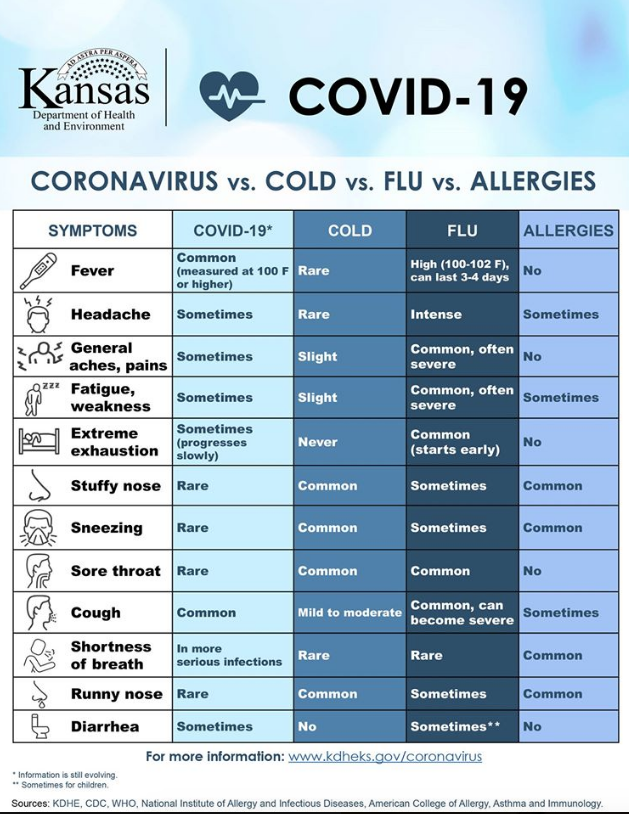
Comparing the various sequelae of flu, COVID19, cold — one might ask WTF is this all about! I have had several battles with the flu — fever , uncontrollable shivers until the fever broke, physical wipe-out for days, no cure, not even feel-better drugs, just stay home and get over it. Based on this chart of amalgamated characteristics, give me COVID19. Why are we not hearing the comparatives as to “flu” statistics? For the record, a medically vulnerable person should be isolated from all of these except perhaps someone with allergies. Thanks to KK for the forward.
The New York doctor also posted a video explaining his success with hydroxychloroquine and Z-Paks. His treatment resulted in the shortness of breath issue being resolved in 4 to 6 hours. Dr. Zelenko in his study had zero deaths, zero hospitalizations and zero intubations!
Later on Monday evening Sean Hannity invited two more medical experts on to discuss Dr. Zelenko’s coronavirus results. The two doctors were cautiously optimistic.
Cuomo spent more money than the cost of the ventilators on a solar panel boondoggle, reports former New York Lieutenant Governor Betsy McCaughey (R) in a syndicated column published this past week. McCaughey reports the Cuomo administration decided instead to establish “triage officers” to decide in a crisis who would get a ventilator and who would be left to die.
NY Gov. Andrew Cuomo gestures toward a hospital ventilator during an interview with CNN New Day co-host Alisyn Camerota, March 19, screen image.
…After learning that the state’s stockpile of medical equipment had 16,000 fewer ventilators than New Yorkers would need in a severe pandemic, Gov. Andrew Cuomo came to a fork in the road in 2015. He could have chosen to buy more ventilators. Instead, he asked his health commissioner, Howard Zucker to assemble a task force and draft rules for rationing the ventilators they already had.
That task force came up with rules that will be imposed when ventilators run short. Patients assigned a red code will have the highest access, and other patients will be assigned green, yellow or blue (the worst) depending on a “triage officer’s” decision. In truth, a death officer. Let’s not sugarcoat it. It won’t be up to your own doctor.
Cuomo could have purchased the additional 16,000 needed ventilators for $36,000 apiece or a total of $576 million in 2015. It’s a lot of money but less than the $750 million he threw away on a boondoggle “Buffalo Billion” solar panel factory. When it comes to state budget priorities, spending half a percent of the budget on ventilators is a no brainer.
Now the pandemic is actually here. Cuomo’s grim reaper rules will be applied. New York City’s deputy commissioner for disease control Demetre Daskalakis is anticipating “some very serious difficult decisions.” So far, in New York City, 1 out of every 4 people with a confirmed case has been hospitalized, and 44% of them have needed a ventilator.
The task force claimed there was no point in buying ventilators because there’s also a shortage of doctors and nurses trained to use them. Five years ago, that problem could have been fixed, too. Even now, the National Disaster Medical System can send staff to hot spots like New York…
NYC Health Officials Urged Crowds on Feb 9th to Gather and “Not Change Plans” Because of the “Coronavirus Scare”: “If you are staying away, you are missing out”
Tucker Carlson called on Democrats in Congress Monday to put aside their “stupid partisan points” and stop “indulging their creepy ideological obsessions” to focus on getting a coronavirus relief bill passed.
Our resources are plentiful – insightful writings accumulated by others — we winnow — you engorge
With a comment or two by us here and there
We do not trust “public health” officials. We are not talking about care providers, the front line people, but rather the statisticians, the number crunchers, the academics, the political advisers who operate in that environment who may also have a political agenda, indeed got into the filed imbued with one. One reason all should be looked on with some skepticism is because they do not get as impacted by their policy recommendations in their ivory towers, rather, perhaps, they get advanced.
They often cannot be proved wrong and they can always fall back on either “better safe than sorry” and the supposed debate ending “if we save one life isn’t it worth it?” Actually the latter comes more from the useful idiots as much of the public health ilk are closet eugenics types and triage fiends and are less concerned with individual life than they should be given credit for.
This critique doesn’t apply to all of them but my instincts are not to trust them without some information on their right to life and philosophical views. Anybody that was favored by the Obama administration is suspect.
The following articles relate to our commentary above and the concerns that engendered it:
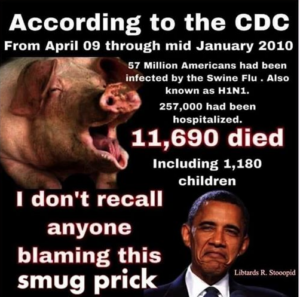
Video of Dr. Fauci in 2009 is Unearthed – Shows a Calm and Unalarmed NIH Chief During H1N1 Epidemic that Killed Over 12 Thousand Americans
The George W. Bush administration published the National Strategy for Pandemic Influenza plan in 2005, which called on the federal government to distribute medical supplies from the Strategic National Stockpile governed by the Health and Human Services Department in the event of an outbreak.
In 2009, the H1N1 outbreak hit the United States, leading to 274,304 hospitalizations, 12,469 deaths, and a depletion of N95 respirator masks. Recommended For You GOP lawmaker: China should face ‘consequences’ for ‘indefensible’ behavior at start of coronavirus outbreak
A federally backed task force and a safety equipment organization both recommended to the Obama administration that the stockpile be replenished with the 100 million masks used after the H1N1 outbreak.
Charles Johnson, president of the International Safety Equipment Association, said that advice was never heeded.
“Our association is unaware of any major effort to restore the stockpile to cover that drawdown,” he said.
HHS Secretary Alex Azar reported last month that only 12 million N95 masks were available in the stockpile, “a tiny fraction of the 3.5 billion masks one of Azar’s deputies later testified the nation’s healthcare system would need,” the Los Angeles Times noted.
Bloomberg News reported similar findings last week, noting, “After the H1N1 influenza outbreak in 2009, which triggered a nationwide shortage of masks and caused a 2- to 3-year backlog [of] orders for the N95 variety, the stockpile distributed about three-quarters of its inventory and didn’t build back the supply.”
Dr. Fauci Wants America to Become a Police State Like China in Order to Stop Coronavirus
Fauci is now seen as an oracle of sorts in the era of the coronavirus.
“I will bring it up at the next task force meeting and see whether there’s some sort of a logistical, bureaucratic reason why it can’t be done. The rationale for doing it is at least worth serious consideration,” he added.
As Americans grow more fearful and desperate because of the coronavirus pandemic, Fauci has emerged as a popular soothsayer to the hapless public. The public increasingly views him as an oracle regarding the virus, and he has played into the role by advocating an increase of authoritarianism at every turn.
“I think Americans should be prepared that they are going to have to hunker down significantly more than we as a country are doing,” he said during a recent appearance on MSNBC’s “Meet the Press,” in which he called for a national shutdown for a minimum of two weeks.
“You know I would prefer as much as we possibly could. I think we should really be overly aggressive and get criticized for overreacting,” he added.
Meanwhile, President Trump is urging people not to overreact to the coronavirus pandemic.
“WE CANNOT LET THE CURE BE WORSE THAN THE PROBLEM ITSELF,” Trump said in a Twitter post on Sunday night. “AT THE END OF THE 15 DAY PERIOD, WE WILL MAKE A DECISION AS TO WHICH WAY WE WANT TO GO!”
However, Fauci has no problem with creeping totalitarianism, suggesting that an unprecedented expansion of government power against the Constitution is nothing to be worried about.
“You don’t want to be complacent. You always want to be ahead of the curve,” Fauci said, “but it depends on how far ahead of the curve you want to be.”
Sarah Hoyt writing at PJ Media has an excellent thought piece on the subject of shaming resistance to public health theories: There are many active links documenting statements made in the original
. . . My personal grandmother, if she were still alive, and they told me I’d need to kill all of you in batch lots to keep her alive – and get to have tea with her – one more day? Let’s just say I’d prefer not to be tempted.
However, that doesn’t make it a good idea.
Why not?
Because by sacrificing our wealth, we’re sacrificing our ability to care for other grandmothers in the future. Absent in the barrage the media is blasting at people is that part of the reason for the triage – known as letting people die – in Italy is the lack of money for the medical system. Now, part of this is because it’s government-run, part is because the Italian economy has been sinking for several years.
Which means that by destroying the economy we’re condemning a lot of grandmas to death. (And that’s without taking into account how poverty increases illness.)
But let’s say – for the sake of argument – we take the left’s idea that it’s worth putting everyone on lockdown to avoid one death.
Well, guys, we’re in trouble now.
Because the number of people who die in the U.S. every year from the strangest things is through the roof.
First of all let’s get the annual flu deaths from an average flu year in the U.S., from a site at random.
If you take the number of deaths year-wise, you will find a vast variation with a low of 3,349 deaths during the flu season of 1986-87 to a high of 48,614 in 2003-04.
For this season this is the current estimate:
222,000 Positively Tested for Flu and 22,000 deaths
Which is probably also a low estimate on how many people had it, because at least for me, the normal answer to calling my doctor and telling them I have the flu is “You probably do. Don’t come in.”
Now, with those numbers putting the COVID-Sars-Wuhan flu in perspective, let’s look at other ways to die that don’t seem to make our media run around with their hair on fire:
. . .
And let’s not forget that in 2005-2014 there were an average of 3,536 fatal unintentional drownings (non-boating related) annually in the United States.
Unlike Cov-Sar-China virus, this scourge falls disproportionately on those under 14, who have their entire lives ahead of them and are of economic importance for the future, at least if you expect anyone to pay for the panic insanity of 2020.
That means they must be saved. Fortunately, the fix is relatively minor. All levels of government must ensure that all Americans wear a lifejacket at all times, even in bed, because the ground could open under your house and drop you into a long-forgotten underground river. If it saves even one life! You’ll sleep with filter-mask and lifejacket on and like it.
Also, since some percentage of these deaths are in the bathtub, these appliances shall now be ripped from every home.
Apparently, more than 27,000 falls led to death in 2014, out of 800,000 falls that led to injury. Like the China virus, this cruel harbinger of doom falls disproportionately on the old and the enfeebled.
From now on EVERY American must wear a complex apparatus composed of stabilizing and catching rods and buffers in case they trip. They will be followed by another American carrying pillows, in case they can’t avoid the fall, so they can cushion it.
Yes, that means Americans will do nothing but follow each other carrying pillows. But hey, if it saves even one life, who are you to say it’s not worth it? What if it were your mother, you unfeeling savage?
The alternative is making everyone crawl on their belly so they can’t fall, of course.
So you see, in the interest of saving even one life, you will now have to crawl on your belly wearing a filter mask and a life preserve, and be handed your vegan (all the animals being dead) disinfectant-impregnated food. (Yes, I do know disinfectant is usually poisonous. But this is a government program, so that’s what you’ll get.)
And you’ll like it! Because if it saves even one life, it’s totally worth it, right?
Fox News contributor Dr. Marc Siegel added his voice to a growing chorus of medical, political and economic experts who are warning that the U.S. must change its approach to the coronavirus pandemic or risk doing more harm to the country than the actual disease.
“About three or four weeks from now, we’re going to back off of these draconian measures because we won’t be able to stay together as a society if we don’t,” warned Siegel on Fox Nation’s “Deep Dive” on Monday.
President Donald Trump also alluded to this concern in a tweet on Sunday, writing in all capital letters, “WE CANNOT LET THE CURE BE WORSE THAN THE PROBLEM ITSELF. AT THE END OF THE 15 DAY PERIOD, WE WILL MAKE A DECISION AS TO WHICH WAY WE WANT TO GO!”
Fox News and Fox Nation host Steve Hilton observed that the economic impact of local, state and federal measures to impose “extreme social distancing” on millions of Americans may plunge the nation into an economic crisis on par with the “Great Depression, perhaps even worse.”
The Wall Street Journal editorial board sounded the alarm on this issue last week in a piece titled, “Rethinking the Coronavirus Shutdown.”
“I would argue that the administration needs to start pivoting and moving to phase two and letting everybody know that this ends on a date certain and that we’re going move to a new approach because we will destroy our economy if this continues much longer,” Strassel contended.
Joel Griffith, a research fellow for the Institute for Economic Freedom and Opportunity at the Heritage Foundation, warned that measures to stop the spread of the virus have pushed too many businesses to the brink of bankruptcy.
“Most of these businesses don’t have cash in the bank that can sustain them past three or four weeks being shut down,” said Griffith. “We can handle a two-week shutdown. We can’t handle a two-month shutdown.
Speaker Nancy Pelosi spent the weekend rejecting every single GOP proposal of the COVID-19 rescue bill to help our economy avoid a total collapse. It sure appears like the Democrats are trying to kill our economy, which is why what this expert doctor in disease prevention is saying sure seems like the truth. Dr. John Ioannidis of Stanford claims more people will die from a potential economic collapse than from COVID-19, and he has the statistics to prove it. You don’t want to miss this.
What if the hysteria by government officials over this pandemic is based on faulty formulas? Well, if you are an expert trying to warn Americans of this possible outcome, you found yourself censored by leftists elites.
Dr. John Ioannidis wrote an extensive piece titled: “A fiasco in the making? As the coronavirus pandemic takes hold, we are making decisions without reliable data.”
“The current coronavirus disease, Covid-19, has been called a once-in-a-century pandemic. But it may also be a once-in-a-century evidence fiasco,” the Stanford expert writes. “At a time when everyone needs better information, from disease modelers and governments to people quarantined or just social distancing, we lack reliable evidence on how many people have been infected with SARS-CoV-2 or who continue to become infected.”
“The data collected so far on how many people are infected and how the epidemic is evolving are utterly unreliable. Given the limited testing to date, some deaths and probably the vast majority of infections due to SARS-CoV-2 are being missed,” he adds.
. . . Dr. John Ioannidis concludes that more people will die from an economic collapse than from COVID-19.
He is not alone. Aaron Ginn and Justin Hart, both statisticians, join Ioannidis in pointing out, in the beginning, the World Health Organization (WHO) based its numbers on faulty formulas. By now, most of you have heard that COVID-19 is more deadly than the yearly flu. However, that stat by WHO was based on a different formula.
The yearly flu stats are based on the total world’s population (a very big number). So, when we translate that into a percentage of the number of people who will die from the flu, the percentage is around 0.1 percent.
WHO did not use the total world’s population. Instead, they used a percentage of those infected who die, and that’s how they came up with the 3.4 mortality rate. The true number of those dying from COVID-19 is the same as the yearly flu, 0.1 percent or less.
“This evidence fiasco creates tremendous uncertainty about the risk of dying from Covid-19. Reported case fatality rates, like the official 3.4% rate from the World Health Organization, cause horror — and are meaningless. Patients who have been tested for SARS-CoV-2 are disproportionately those with severe symptoms and bad outcomes. As most health systems have limited testing capacity, selection bias may even worsen in the near future,” Dr. Ioannidis said.
You have also heard that this virus is much more contagious. This is also a fallacy.
Dr. Paul Auwaerter, the Clinical Director for the Division of Infectious Diseases at Johns Hopkins University School of Medicine says transmission of COVID-19 is also similar to the seasonal flu.
“If you have a COVID-19 patient in your household, your risk of developing the infection is about 10%….If you were casually exposed to the virus in the workplace (e.g., you were not locked up in conference room for six hours with someone who was infected [like a hospital]), your chance of infection is about 0.5%,” Dr. Auwaerter said.
Those numbers reflect what we see in the seasonal flu and is the point the good doctor from John Hopkins is making. All these experts also say one of the best instances we can use to see real numbers of this pandemic happens to be what went down on the cruise ship the Diamond Princess.
“The one situation where an entire, closed population was tested was the Diamond Princess cruise ship and its quarantine passengers. The case fatality rate there was 1.0%, but this was a largely elderly population, in which the death rate from Covid-19 is much higher,” Dr. Ioannidis said.
“Projecting the Diamond Princess mortality rate onto the age structure of the U.S. population, the death rate among people infected with Covid-19 would be 0.125%. But since this estimate is based on extremely thin data — there were just seven deaths among the 700 infected passengers and crew — the real death rate could stretch from five times lower (0.025%) to five times higher (0.625%),” Ioannidis concludes.
This still comes nowhere near to the 3.4 percent projection from WHO that drove our government officials to shut down the U.S. economy.
“A population-wide case fatality rate of 0.05% is lower than seasonal influenza,” Dr. Ioannidis points out. “If that is the true rate, locking down the world with potentially tremendous social and financial consequences may be totally irrational. It’s like an elephant being attacked by a house cat. Frustrated and trying to avoid the cat, the elephant accidentally jumps off a cliff and dies.”
All of these experts’ work is being censored. Google warns you that “the following information may be unreliable” before you can click to proceed to view their work. Well, never fear. It sure looks like President Donald Trump has gotten wind of these expert opinions:
“WE CANNOT LET THE CURE BE WORSE THAN THE PROBLEM ITSELF. AT THE END OF THE 15 DAY PERIOD, WE WILL MAKE A DECISION AS TO WHICH WAY WE WANT TO GO!” Trump tweeted.
“I don’t pretend to be speaking for everyone 70 plus, but I think there were lots of grandparents out there who would agree with me that I want my grandchildren to live in the America I did,” Patrick told Carlson in the text. “I want them to have a shot at the American Dream but right now this virus which all the experts say that 98% of all people will survive is killing our country in another way. It could bring about a total economic collapse and potentially a collapse of our society. So I say let’s give this a few more days or weeks but after that, let’s go back to work and go back to living. Those who want to shelter in place can still do so, but we can’t live with this uncertainty.”
“I am living smart, listening to the president, the CDC guidelines like all people should, but I am not living in fear of COVID-19,” Patrick said, acknowledging that he is in the “high risk” group. “What I’m living in fear of is what’s happening in this country. No one reached out to me and said, as a senior citizen, are you willing to take a chance on your survival in exchange for keeping the America that all America loves for your children and grandchildren? And if that’s the exchange, I’m all in.”
Explaining that he has six grandchildren and that his position doesn’t make him any more “noble or brave” than anyone else, Patrick contended that he doesn’t “want the whole country to be sacrificed.”
“And that’s what I see,” he said. “I’ve talked to hundreds of people just in the last week and making calls all the time and everyone says pretty much the same thing, that we can’t lose our whole country. We are having an economic collapse.” (RELATED: ‘The Most Hopeful Thing I Have Heard’: Adam Carolla Impresses Tucker With Philosophical Take On Coronavirus Crisis)
“So my message is that let’s get back to work. Let’s get back to living,” Patrick said. “Let’s be smart about it and those of us who are 70 plus, we’ll take care of ourselves, but don’t sacrifice the country. Don’t do that. Don’t ruin this great American dream.”
When asked whether he meant that there are things “worse than dying,” Patrick agreed, saying, “I’m not trying to think of it in any kind of morbid way, but I’m just saying that we’ve got a choice here, and we are going to be in a total collapse, recession, depression, collapse in our society. If this goes on another several months, there won’t be any jobs to come back to for many people.”
The US coronavirus mortality rate dipped to 1.25% on Sunday using deaths (396) divided by confirmed cases (38,167).
That number is actually SIGNIFICANTLY lower if you factor in ALL OF THE CASES that are not being reported, where people are not feeling sick enough to be tested. That number could be 6-7 times higher than the current number of 38,167. The mortality rate for the coronavirus in the US continues to fall as more and more Americans are able to be tested. 12 days ago the US coronavirus mortality rate was 4.06 Today the mortality rate is down to 1.25%!
4.06% March 8 (22 deaths of 541 cases) 3.69% March 9 (26 of 704) 3.01% March 10 (30 of 994) 2.95% March 11 (38 of 1,295) 2.52% March 12 (42 of 1,695) 2.27% March 13 (49 of 2,247) 1.93% March 14 (57 of 2,954) 1.84% March 15 (68 of 3,680) 1.6% March 17 (116 of 7,301) 1.4% March 19 (161 of 11,329) 1.25% March 20 (237 of 18,845) 01.0% March 22 (396 of 38,167
Thanks to the fraudulent numbers by the WHO the global economies are in a complete meltdown over the coronavirus panic.
Now, after several days of testing, the numbers are starting to look more and more like what you would expect from a harsh flu season.
PERSPECTIVE:
** The 1918 Spanish Flu Pandemic killed 675,000 out of US population of 103,268,000 or about — 1 in 200 ** The 2020 Coronavirus has killed 396 (so far) out of a population of 333,546,000 or a little more than — 1 in a million
As we have reported several times now — the Director of the World Health Organization created an international panic when he miscalculated the coronavirus mortality rate at 3.4%.
The controversial Ethiopian politician and Director General of the World Health Organization (WHO), Tedros Adhanom Ghebreyesus, claimed in a press conference in early March that the fatality rate for the coronavirus was many multiples that of the fatality rate of the common flu.
This egregiously false premise has led to the greatest economic panic in world history.
The Director General of the WHO spoke on March 3, 2020 and shared this related to the coronavirus:
While many people globally have built up immunity to seasonal flu strains, COVID-19 is a new virus to which no one has immunity. That means more people are susceptible to infection, and some will suffer severe disease.
Globally, about 3.4% of reported COVID-19 cases have died. By comparison, seasonal flu generally kills far fewer than 1% of those infected.
Here is the video of Dr. Ghebreyesus’s remarks.
This statement led to the greatest panic in world history as the global elite media shared and repeated that the coronavirus was many, many times more deadly than the common flu.
The problem is his statement is false.
It was not accurate!
As The Gateway Pundit reported Monday, the coronavirus mortality rate reported by the media as stated by Dr. Ghebreyesus is completely inaccurate.
He overstated the coronavirus mortality rate. You can read more on that here.
According to the weekly CDC flu report — flu deaths are up by 1,000 over last week. And according to the global coronavirus trackers US coronavirus deaths are up by 396 for the entire year on Sunday.
The coronavirus panic may end up mathematical error in global history.
Recommended articles, links and excerpts. If there is some information or an article that you have run across that is instructive please forward a link. (Graphics via HP or others not part of originals)
The stock market tanked. Thousands of small businesses went bankrupt, millions closed their doors and wonder if they will be able to survive once they re-open.
Amidst all of the attempts to flatten the curve, increase the number of testing locales and kits available, and randomly requiring people to stay at home the number of confirmed infections went up—while the percentages of deaths related to them went down.
Most importantly, an on-the-shelf cure for COVID-19 has finally been authorized. It has a 99.75 percent effectiveness in controlled studies.
I interviewed the co-author, Gregory Rigano of Johns Hopkins and Stanford, about the reliability of the studies.
But what good is it to know that a cure exists that stops the virus and dismantled it in 99.75 percent of the cases it is studied in if the Surgeon General is still claiming day and night on every news channel that its effectiveness is not yet proven?
Multiple controlled studies, the most significant one authored by Dr. Didier Rauolt in southern France, have seen that 99.75 percent cure rate be matched over and over.
Lennox Hill Hospital in New York has even adopted the HydroxyChloroquine formula, and they have yet to lose even a single victim to COVID-19 of their more than 100 cases that they are treating.
Nonetheless, the panic-driven media, the big money-lust vaccine research grant types, and the swampy Surgeon General are still dismissive of the idea that a cheap, inexpensive-to-produce, readily available anti-viral that was created in 1934, used widely in 1945, and known to be effective against viruses since the 1970s should be the end of a virus that has killed off life in America.
So here’s what we need to do to bring this thing to an end so that America can begin the larger recovery:
Adopt immediate use, in the recommended dosages in Dr. Rauolt’s study, for frontline medical workers. The CDC says it is effective as a preventative. Then let’s arm up the heroes of this battle so that they are protected.
Immediately begin prescribing for worst cases (elderly, asthmatic, upper respiratory vulnerable), then those who have contracted, then those who have positive tests, and lastly those merely exposed. Do it in this order and start yesterday. American companies should be able to produce between 15-20 million more pills before the end of this week. Be generous. I know of one small business owner who has already paid the rent/mortgage for Broadway ushers, eatery waitstaff, and others he’s learned of. That’s the spirit of Americans coming together.
Originate the stimulus only for those in need. This “$2,000 in every pocket” idea sounds nice—and is a windfall for many, but for those who have effectively lived within their means, there is no real reason to shell out the money.
Open businesses a week from Monday. The pain has been severe, even as eateries have tried to convert to curbside delivery they are still shedding losses of enormous amounts. Same with barbershops, retailers, cinemas, and gyms.
. . .
Refuse to fear. The media, the swamp, and politically motivated Never Trumpers, Democrats, and the left are all trying to get you to lose your mind. Don’t let them. Clean and reload all the firearms in your home. Participate with your friends through their social media push-up challenges. Take an Instagram yoga time out. Enjoy the free American Ballet Theater virtual ballet classes with your baby girl. Or send your boys to their virtual Taekwondo class on YouTube. Live, and never let anyone stop you.
Fourteen days ago the “experts” predicted we’d be out of hospital beds in 10 days.
We’re not even close.
The regular flu has taken 13,000* American lives this flu season, out of 38,000,000 being infected. COVID-19 has yet to infect even a million people on the entire planet thus far and as of this writing for roughly the same period as the flu, the Wuhan coronavirus has killed 300 Americans.
The cure has been found. Stay calm. Enjoy this week with your family. Live your life.
What’s more, most patients cleared the virus in three to six days rather than the 20 days observed in China. That reduces the time a patient can spread the virus to others. One lesson that should inform the U.S. approach: Use this treatment cocktail early, and don’t wait until a patient is on a ventilator in the intensive-care unit.
As a matter of clinical practice, hydroxychloroquine should be given early to patients who test positive, and perhaps if Covid-19 is presumed—in the case of ill household contacts, for instance. It may be especially useful to treat mild cases and young patients, which would significantly decrease viral transmission and, as they say, “flatten the curve.”
Emergency rooms run the risk of one patient exposing a dozen nurses and doctors. Instead of exposed health workers getting placed on 14-day quarantine, they could receive hydroxychloroquine for five days, then test for the virus. That would allow health-care workers to return to work sooner if they test negative.
President Trump touted hydroxychloroquine in his Thursday press conference as a potential treatment, which is a welcome move. And this isn’t only about treatment. Rapid and strategic use of these drugs could help arrest the spread of the disease.
Vik Khanna, a retired health-care consultant and an alumnus of the Johns Hopkins University School of Hygiene and Public Health writes at the Federalist (excerpts)
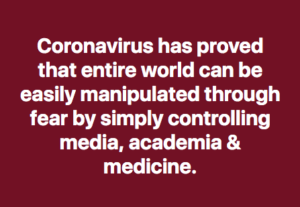
In the time of the Wuhan virus, we should remind ourselves that we are trusting our collective fates to the exhortations and exclamations of politicians, media, academics, and a public health establishment that have spent almost four years on the frontlines of the #NotMyPresident movement. Many of the claims being made about how the Wuhan virus is the plague for our times are founded on remarkably weak data sets that are intentionally manipulated to foment fear.
When estimating the impact of an infectious disease on a population, it is vital to know at least four important data sets:
People exposed to the virus who do not get infected. The president himself falls into this category. When people are exposed but don’t get infected, given that we do not have innate immunity, we need to know much more about the duration and intensity of exposure to deduce what behaviors and interactions are actually risky.
People exposed to the virus who are infected (i.e., carriers) but don’t get sick. To know the data for this group and the one above, periodic random sampling and epidemiologic surveys are necessary.
People who are exposed, infected, and get sick. Within this group, there are three additional strata to know: mildly ill, seriously ill, and critically ill.
People who are exposed, infected, get sick, and die. We already have data pointing to high-risk groups such as the elderly and immunocompromised. There will also obviously be outliers, just as there are every year when younger, ostensibly healthy people die unexpectedly of the flu.
The disaster occurring in Italy is not unexpected; it is the natural result of combining a nationalized health-care system with an elderly population and slowly implemented travel controls. Japan, which has a population older than Italy’s, is not suffering nearly as much. Why not? Because of a powerful clamp down on travel.
We have almost no credible information about the first two of the four groups listed above, because we are not randomly sampling and surveying in areas that are most heavily affected, such as the international gateway cities and their surrounding communities. By concentrating on testing primarily people who meet specific criteria (e.g., symptoms and travel history), the death rate looks scary because the denominator is small.
Even the way information is presented and uncritically reported inflames and scares: 2.2 million Americans will die; 100,000 Ohioans infected; 150 million Americans will get the virus. Erika Edwards of NBCNews waits until the end of her article before reporting that severe cases and deaths are not the norm, and that 80 percent of people who get sick do just fine. Models and projections are only as credible as their assumptions (see man-made global warming, by Al Gore), and we have no idea whether our present models are projecting accurately.
China’s ‘Data’ Is Worthless
China, which gave us the virus, claims known cases have leveled off in the four months since patient zero at 81,000 in a population of 1.4 billion people, for a prevalence rate of 0.0057 percent. Their official mortality number is that Wuhan has caused 3,260 deaths, which is 0.03 percent of the more than 10 million deaths in China each year.
China also claims it did not steal American intellectual property, did not imprison Uighur Muslims, and did not try to destroy political freedoms in Hong Kong. You can believe what you will from China, but it might be wise to lean on the old Russian proverb “doveryai, no proveryai”—trust, but verify. I see no one undertaking the onerous task of data verification in the Middle Kingdom.
Democratic governors, mayors, and their public health trolls have placed the blame for the virus at the foot of the president instead of where it belongs: in an authoritarian third-world state with a per-capita economic product that is less than one-fourth of West Virginia’s—ironically, the last state to show a case of Wuhan flu. China’s communist government not only lied about the eruption of the virus but willfully exported it to the civilized world. What better way to dismantle the presidency it loathes? The lesson to be learned is that we cannot trust opaque totalitarian regimes.
Smart Decisions Don’t Come From Garbage Data
Had the White House shut down travel from China in early January, when it was clear that something was very wrong in Wuhan, it would have been not just right, but prescient. That would have been a true victory for public health in the United States, even if it had inconvenienced tens of thousands of travelers. Instead, we have turned a $20 trillion economy on its head, endangered the livelihoods of tens of millions, and appear ready to use this crisis as an Obama-esque wealth redistribution scheme.
This is a time for caution and personal responsibility, but a strategic public health response is not built upon hysterics, half-baked data sets, and political motivations. Really, how much effort does it take to doubt our health policy machinations?
. . .
The most important, and unstated, assumption underlying many Wuhan virus models and pronouncements is that this is the long-sought tool to overturn Trump’s 2016 election. Is there any economic or human cost that would give pause to the coastal intelligentsias and their histrionics as long as it evicts Trump from the Oval Office?
The same cabal that has spent the last decade telling us all there is an “epidemic” of gun violence in America, even though the gun homicide rate has fallen 50 percent in 25 years and is still falling, is engaging in a political con no one wants to talk about. Aeschylus was right: truth really is the first casualty of war.
Victor Davis Hanson at American Greatness (excerpts)
When your refrigerator goes out under quarantine and your supplies begin to rot, do you really need another rant from Maxine Waters—or do you rather need a St. Michael Smith and St. Uriel Mendoza to appear out of nowhere as the archangels from Home Depot to wheel up and connect a new one?
In all the gloom and doom, and media-driven nihilism, there is actually an array of good news. As many predicted, as testing spreads, and we get a better idea of the actual number and nature of cases, the death rate from coronavirus slowly but also seems to steadily decline.
Early estimates from the World Health Organization and the modeling of pessimists of a constant 4 percent death rate for those infected with the virus are for now proving exaggerated for the United States. More likely, as testing spreads, our fatality rates could descend to near 1 percent.
There is some evidence from Germany and to a lesser extent South Korea, that it may be possible to see the fatality rate dip below 1 percent. And with the breathing space from the lockdown, better hygiene (the degree of constant and near-obsessive cleaning at businesses that are still open is quite amazing), more knowledge and data, better medical protocols, the use of some efficacious drugs, warmer weather, and experience with the disease will, in perfect-storm fashion, begin to mitigate the effects of the virus.
Should we get the lethality rate down to German levels (currently two to three in 1,000), then we can cautiously assume that those who predicted that the coronavirus could eventually be contextualized as a bad, H1N1-like flu will no longer be demonized as nuts, and life can resume with reasonable precautions and focused quarantines and isolation.
In two or three weeks, if we can just allow most businesses to reopen, gear up to pandemic testing, track cases and contacts in the manner of past protocols that lessened polio, tuberculosis, AIDS, and measles outbreaks, and focus on the ill and elderly, then the economy will reboot.
But now the current economy is starting to resemble a patient in an induced coma, one whom no one knows whether he will recover after the respirator is disconnected. But still, there are reasons for optimism: historically low interest rates will eventually encourage bit-ticket buying.
After any war or national crisis, confidence soars with collective relief and people go out to eat, travel, buy, and consume. Airlines, and the entire commercial and private transportation sector, will receive a multi-billion-dollar subsidy in radically reduced gas and diesel prices. The same holds true for the utilities.
. . .
Nations, if wise, will question Chinese reliability, transparency, and truthfulness as never before—despite likely Chinese discounts and outreach to maintain relationships. Many will still conclude that the upside of cheap labor cancels out the downside of dependency on such an unreliable and odious government partner.
In American terms, Trump’s supposedly quixotic effort to decouple key industries from China will no longer be the stuff of bemused scorn, but the new orthodoxy, with obvious advantages for the United States in terms of autonomy and autarky of life-sustaining goods—not to mention U.S. jobs.
. . .
There is a golden opportunity for U.S. corporations to return to America and to become what has been called the new Roosevelt “arsenal of democracy,” the world’s supplier of medical supplies and pharmaceuticals that nations count on in times of crisis.
The Media
Everyone knew before just how biased and unprofessional the media had become in its maniacal hatred of Donald Trump. But few appreciated how uneducated, arrogant, and clueless about simple calculations and logic was this generation of reporters that has emerged from politicized schools of journalism, which taught therapy rather than knowledge, much less a code of conduct.
The media daily blares out preliminary models and data, without even the most remedial context. They parrot the supposedly historic death rate of the virus, without any knowledge that the numerator of virus cases is as inaccurate and misleading as the denominator of deaths is mostly factual.
Then they seemed surprised that the death rate dips as tests and supposed cases spread, without any appreciation that known cases are likely not representative of the populace as a whole, but represent only those who were tested (80-90 percent negative), and thus only of those who felt ill or were exposed enough to be tested. Few tell us that a small percentage of those tested, when ill, have COVID-19, or the death rate is warped by those over 70 with accompanying heart, respirator, and cancer challenges.
When journalists talk of “20,000 cases!” they never remind their readers that nearly 99 percent recover from the virus that has stealthily been with us likely since mid-January, and of those 20,000 or so cases, a large number of the sick are already well. There is now a parlor game on the Internet of cutting and pasting clips from cable news, PBS, and NPR to reveal how inane and unthinking reporters have become.
Not so long ago, it was “bombshells,” “turning points,” “game-changers,” and “walls are closing in” to assure us that Robert Mueller was about to indict the entire Trump team. And now “we will never be the same,” “worse than the 1918 flu,” “xenophobia,” etc. have become the new parroting. Only an ignoramus or worse, would employ the terms “Chinese virus” and “Wuhan flu” for most of January and February, and then suddenly declare such terms racist when Donald Trump or his supporters copied such common media parlance.
Whereas no one believed the media in the past, no one especially likes them now, either. The more they in Pavlovian fashion equate coronavirus with the Spanish flu epidemic of 1918, and Trump with Hitler, the more people, to the degree they hear of such silliness, tune them out.
Relative Value?
I think one of the strangest of all sequelae to the virus and the lockdowns might be the millions of high-paid Americans whose absences were hardly missed either by the public or count much in subsequent economic analyses of damage to the economy.
In a sophisticated society under lockdown, is it more existentially valuable to know how to fix a toilet, replace a circuit breaker, or change a tire, or to be a New York fashion designer, a Hollywood actor, or a corporate merger lawyer? At 9 p.m., when you go downtown in need of a critical prescription, are you really all that furious that a law-abiding citizen who has a gun and concealed permit is also in line—or would you be more relieved that gun control laws might ensure that his ilk never enters an all-night pharmacy?
So who is important and who not?
We were often told globalized elites on the coast were the deserved 21st-century winners, while the suckers and rubes in-between had better learn coding or head to the fracking fields.
But who now is more important than the trucker who drives 12-hours straight to deliver toilet paper to Costco? Or the mid-level manager of Target who calibrates supply and demand and is on the phone all day juggling deliveries before his store opens? Or the checker at the local supermarket who knows that the hundreds of customers inches away from her pose risks of infection, and yet she ensures that people walk out with food in their carts? The farmworker who is on the tractor all night to ensure that millions of carrots and lettuce don’t rot? The muddy frackers in West Texas who make it possible that natural gas reaches the home of the quarantined broker in Houston? The ER nurse on her fifth coronavirus of the day who matter-of-factly saves lives?
Do we really need to ask such questions of whether the presence of the czar for diversity and inclusion at Yale is missed as much as the often-caricatured cop on patrol at 2 a.m. in New Haven?
Do social justice student protestors who surround and heckle the politically suspicious now in ones and twos also scream in the faces of the incorrect plumber who unclogs their locked-down apartment drain? . . .
I drive extensively in this bi-state metro area of about 350,000 people. The economic impact of the government imposed measures, federal, state and local, to combat the spread of the Wuhan virus already appears devastating. It will likely get worse as businesses that are trying to cope layoff more people.
Empty parking-lots at restaurants and entertainment venues of all sorts, schools, doctor’s offices — vacant. Reduced hours most other places. There will be a domino effect from each sector to others . . . hard-good sales and manufacturing, home-building, auto sales and their manufacture . . . will feel the effect as the directly affected businesses and their employees do not spend. Tax coffers will maybe be a bit flush for a short time after the recent profit taking from the stock market panic, but it will not be sufficient to make-up for the lost sales taxes and other revenue, or the outlays for unemployment and welfare caused by policies imposed by government.
Wayne Allen Root joins our concern that there must be a better way to combat the effects of the Wuhan pandemic then what is getting close to martial law.* Following this we have some questions for readers and invite their reflection and feedback.
Great job, President Trump. You’ve done the impossible. You’ve turned perhaps the worst crisis in USA history and one of the darkest periods Americans have ever suffered into a show of leadership and a jump in approval.
The latest ABC News/IPSOS poll shows a dramatic turnaround. At 55% to 43%, Americans approve of President Donald Trump’s handling of this crisis. The numbers were nearly completely reversed only a week ago. Bravo.
But I have some advice you need to hear.
Now, keep in mind, I’m not one of the people who ever said this was a hoax. It’s 100% real. It’s a terrible health care crisis and tragedy.
But did it have to be a terrible economic crisis and tragedy, too? And who does that help, exactly? If Grandma, Grandpa or someone you love is sick, critically ill or, God forbid, at death’s door, does it help that you’ve also lost your job, or your small business has just closed? Does it help that you just lost your income or life savings? Do you feel better about a health tragedy if you also have a personal economic tragedy to deal with?
The common-sense answer is of course not.
That’s why we should follow the South Korean model, or at least as close to it as possible. The country has had the most success in the world at fighting and surviving the coronavirus pandemic. In a nation of 51 million (about 10 million more than the population of California), South Korea has had under 9,000 cases and under 100 deaths. CARTOONS | AF Branco View Cartoon
So why is the governor of California, Gavin Newsom, predicting that roughly 25.5 million of his citizens will get the virus? On what is he basing that number? If he assumes a 3% mortality rate, he must expect 500,000 to 1 million deaths just in California. But based on what?
And is it irresponsible to scare his citizens half to death with over-the-top, hysterical, worst-worst-worst-case guesses modeled on computers?
Keep in mind the Centers for Disease Control & Prevention predicted over 1,000,000 cases of Ebola in Africa just a few years back. The actual number? Under 30,000. These are guesses on a computer screen — hysterical, worst-case guesses.
These are two places similar in size, yet the governor of California is expecting a million deaths in his state versus under 100 deaths in South Korea? And Newsom is shutting down the state and California’s economy based on those wild, worst-case guesses?
Even if, God willing, we beat this terrible virus, what’s the point if, after it’s all over, we face a ruined economy, no job, a bankrupt business, no assets, no way to pay bills? This is madness.
Or what if COVID-19 turns into COVID-20 through COVID-30 and they attack us repeatedly over the next decade? Will we close down the economy twice a year every year?
Try that a few times and we’ll all be living in caves, using candles for light and newspapers for toilet paper, and carrying our supplies home on donkey carts. America will be a combination of Venezuela and “Mad Max.”
My idea from day one was to put those already sick, the elderly, those with compromised immune systems and those at highest risk in quarantine for one to two months.
But ask and encourage everyone else — the young, the healthy, business owners and their employees — to carry on and live life. Those least at risk should be asked to keep their businesses open, keep the economy going, go out to eat, keep their communities’ small businesses in business, all so the sick, elderly and at-risk population have something to come back to in one to two months.
That’s a Winston Churchill-like, stiff-upper-lip response.
I dare you to ask all those who are now laid off, jobless or with shuttered businesses whether they’d be willing to risk getting sick, or even risk a small chance of dying if they could get their business or job back. I’m betting the answer from a vast majority would be an emphatic YES! Let’s put the heroes of the American business world to work!
The healthy need to go on living. We need to keep commerce going. Someone has to pay the bills and taxes, or our nation will be in ruins — even if we beat this monster.
I found out yesterday from Dr. Mehmet Oz, a brilliant, breath-of-fresh-air guest on my national radio show, that this is almost exactly the plan carried out in South Korea. The sick and at-risk were quarantined. Everyone else went to work. No businesses were closed. No economy was shut down. Now there’s under 100 dead in a country of 51 million. And they still have their economy and jobs.
So, Mr. President, please study the South Korean model. Let’s not ruin the greatest country and economy in world history. The business of America is business. Let’s get back to it — while we protect the most vulnerable and fight this terrible virus with everything we’ve got.
Wayne Allyn Root is a CEO, entrepreneur, bestselling author, nationally syndicated talk-show host on USA Radio Network and the host of “The Wayne Allyn Root Show” on Newsmax TV nightly at 11 p.m. Eastern/8 p.m. Pacific.
Reflecting:
Readers — what do you have to say to lend perspective, challenge, or critique the more focused approach Root describes about South Korea which we also favor? Certainly the Chinese communists are culpable and changes relative to that country are in order to say the least, but what of failures in public health elsewhere that are more innocent?
Are we going to do the shut-down the economy on their say so for every new strain of flu that reaches “pandemic” stage? From all that is known about it corona is not Ebola, which is super dangerous to all. COVID 19 is no more debilitative, maybe less so, to most who contract it than other flu types which means 98% plus of people in general who contact it get over it. Those who are medically vulnerable (diasgnosed or undiagnosed) would be endangered to a great extent by any flu. So the big question is, is all this really necessary to save the vulnerable or would a very rigorous approach focused on them actually be more effective at saving lives and the economy that helps save lives?
Rather than shut down a restaurant, a gym, a beauty parlor, why not have greatly enhanced (reasonable) cleanliness standards and certification — provide owners an either /or decision about their operations in such circumstances — rather than lock the doors for weeks or months and depend on bailouts or bankruptcy?
Other questions:
Is this going to change society, trade . . . what impact on culture, good-bad and indifferent will this have? I worry about the resignation to this in some quarters but am heartened by the befuddlement (common sense not yet being acted on) which may gel to the point of demanding that enough is enough and expose much public health expertise as actually fraudulent, fostering of hysteria, and CYA nonsense.
We will concede that if we can learn from this and garner perspective those lessons can be compensatory to some extent . Articles about ending dependence on China for strategic manufacturing and reduced dependence on globalization speak to this, all of which we favor. But they beg the question, is this drill necessary? And there are social freedom sequela to this — are bad precedents being set? Is the thought that ~~ “better we over-react than ‘risk lives'” un-challengeable when over-reaction also risks lives and well-being? Saving the vulnerable is an absolute but friendly-fire is not something to be cavalier about in the process.
R Mall
*By the way if the Wuhan virus is a real pandemic then the word ought to lose its impact as are not the rinovirus and various flu types also pandemic in that they have caused more deaths at this stage of the cold and flu “season.”
‘Economic distancing’ could return health, confidence to shaken US public and economy, say experts
I agree, but to be fair, we should take back our automotive, Apple products, and pharmaceutical industries, and give China the National Basketball Assn. (NBA)…oh, and they could keep Nike.
Gregory Rigano, an advisor to the Stanford University School of Medicine, claimed on Wednesday that a French researcher who is well respected in his field had tested a hopeful cure for coronavirus.
‘100% of patients treated… were virologically cured’
“Full peer-reviewed study has been released by Didier Raoult MD, PhD. After 6 days 100% of patients treated with HCQ + Azithromycin were virologically cured,” Rigano tweeted.
Rigano followed up with an appearance on Fox News Wednesday, where he said (emphasis added), “And I’m here to report that as of this morning, about 5:00 this morning, a well-controlled peer-reviewed study carried out by the most eminent infectious disease specialist in the world—Didier Raoult, MD, PhD—out of the south of France, in which he enrolled 40 patients, again, a well-controlled peer review study, that showed a 100 percent cure rate against coronavirus.”
“The study was released this morning on my Twitter account, @Riganoesq as well as our most recent website, @covidtrial.io” Rigano continued. “The study was recently accepted to the International Journal of Antimicrobial Agents by Elsevier.”
“In fact to be able to cure a virus was said to be mathematically impossible, and the first company that did it was a small biotech called Pharmacet that was acquired by Gilead Sciences in a cure for hepatitis C. What we’re here to announce is a second cure to a virus of all time,” Rigano added,`
Study in Australia
V’PAC note: This one seems shakier as we can kill any virus in a test tube with a drop of bleach.
In addition to this promising news, The Daily Wire reported Monday that an Australian team had announced they believe to have found a cure for coronavirus.
“According to infectious disease experts at the University of Queensland in Brisbane, Australia, they may have found a treatment that could possibly eliminate the coronavirus,” reported The Daily Wire.
“University of Queensland Centre for Clinical Research director Professor David Paterson told news.com.au today they have seen two drugs used to treat other conditions wipe out the virus in test tubes,’ News.com.aureported Monday.”
French Peer-Reviewed Study: Our Treatment Cured 100% Of Coronavirus Patients https://t.co/yuJELmwOpJpic.twitter.com/GFiE4mxDnL
— The Daily Wire (@realDailyWire) March 19, 2020
“The two medications Paterson referred to are Chloroquine, an anti-malarial drug, and HIV-suppressing combination lopinavir/ritonavir,” the report continued.
“Paterson told the outlet that it seemed reasonable to call the drugs ‘a treatment or a cure … It’s a potentially effective treatment. Patients would end up with no viable coronavirus in their system at all after the end of therapy.”
Obviously these reports are promising given what the U.S. and the world are going through thanks to the global coronavirus pandemic. Stay tuned. . . .
Hopefully this will signal a return to normality. https://t.co/L4ENpNX94f
— Graeme Hall (@GraemeNZ01) March 19, 2020
We heartily agree with the following:
Blabber Buzz sourced this article from Breitbart
GOP Rep. Palmer: Trump’s Early Acts Lessened Coronavirus Impact — Calls to Incentivize U.S. Businesses to Diversify Supply Chains
Representative Gary Palmer (R-AL), the chairman of the House Republican Policy Committee, argued when the time is right, the U.S.
government should explore ways not to be as reliant on countries in the other hemisphere for manufacturing.
Palmer offered those remarks during an interview that aired on Huntsville, AL’s WVNN, noting it was not just pharmaceuticals threatened by China in the wake of the coronavirus pandemic but other essential elements required to make American technology function.
“I’ve been saying for a long time that we are putting ourselves in serious jeopardy by having a single-source supply chain in one country,” Palmer said.
“And I would say that if it were any other country, particularly China. I mean, most of these flu-type viruses come out of China. From my perspective, it was just a matter of time before something came out like this. But the other thing is China is not our friend.”
“It’s not just the pharmaceutical supply chain that has been fully exposed and putting things in jeopardy,” he continued.
“It’s things like rare earth metals that are necessary for your smartphone and your computers — even the avionics on our fighter jets. China is the only place to get them. I started talking about this a while back, probably two or three years ago and was particularly focused on the rare earth metals and things like that. But also in the last few weeks, I started pitching the idea that we need incentivize businesses to diversify their supply chain.”
Ideally, the Alabama Republican argued the supply chain would exist in countries with which the United States was aligned.
I would prefer they bring it back to the U.S., or at least the Western Hemisphere — to countries that are our ally. I think that’s what you’re going to see — some accelerated plan for giving accelerated depreciation tax credits to help move these supply chains back to this country,” Palmer added.
Palmer was not critical of Trump’s response to date on the coronavirus but instead complimentary. According to Palmer, had Trump not taken an aggressive tack toward China, the United States might be worse off in dealing with coronavirus.
“The fact that the president took on China the way he did early on — people construed that as a trade war,” Palmer added.
“Really, what it was doing was confronting China’s long-term ambitions to become the dominant superpower in the world. And that’s why they were spending all this money in the Belt and Road Initiative, doing all this infrastructure in these countries. Italy, by the way, was the first European Union country to sign on with China in letting China build out their infrastructure. And they refused to shut off travel in and out of China — and now they’re a dumpster fire over there with the virus. The president took on China, and as a result of him cracking down on the trade issue, a lot of companies had already transitioned away from China.”
“I think this could have been a lot worse than it is going to be because of that,” he continued.
“And I know for a fact that the president was engaged on the coronavirus early because as part of Republican leadership — we had lunch with on January 27 at the White House. And he had been on the phone with [Chinese President] Xi Jinping, and Xi Jinping assured him they had the virus under control. And then the president had wanted to send some of our folks in from the CDC. Xi Jinping wouldn’t allow that. It was just a few days later the president banned travel into and out of China. I think he got a tremendous amount of criticism, was called a racist and xenophobes. He did exactly the right thing, and I think again there it lessened the impact this could have been.”
This article was sourced by Blabber Buzz from Political Insider and NY Post
More than 99% of coronavirus patients who died in Italy suffered from other, pre-existing health issues, according to a study by the country’s health officials.
The new research from the National Institutes of Health released Tuesday evaluated 355 of the country’s fatalities and found that only three patients had no prior medical conditions.
Nearly half the COVID-19 victims suffered from at least one of the following conditions: high blood pressure, diabetes or heart disease.
More than 75% reported high blood pressure, while 35% had diabetes and 33% had heart disease, according to the study.
The average age of the victims was 79.5, and the number of deaths in the country surpassed 2,500 this week.
Italy has seen double the rate of coronavirus fatalities compared to the rest of the world. Related Video
References and related reading will be added to this post later today
A report we read recently is that our country has had 20,000 deaths due to flu (other than COVID 19) this season already. It is not unusual for it to range much higher. Where are the leading media’s perspective reports on that? Is Wuhan coronavirus an add-on to that or ultimately just a different source to what is a typical range of rates, deaths from pneumonia and the like, no matter the viral agent?
The death rate often quoted as regards COVID 19/Wuhan coronavirus will likely go down as it is based on known infections. More testing and the denominator will increase likely reducing the statistical percentage rate.
Other statistically ameliorating factors relate to the gee wiz about how long “COVID 19” can live on surfaces. With all the studies of flu and colds over the years, searching for cures and vaccines, the estimates of how long are a range with greatly decreasing efficacy of the virus with passing minutes.
In all cases viruses of all sorts live longer on non-porous surfaces. Cloth and fabrics and paper leach away their membrane coatings and they die quicker.
However the norovirus, (which is not a coronavirus which are comparatively fragile) cna live for days on non-porous surfaces. The bird flu virus measuring at the outside in days has a comparatively longer efficacy as is said of the COVID 19. But there was not near the panic in those outbreaks. Type A influenza is said to live up to two days. These estimates, including as regards “days” for COVID 19 are at the extremes but that is what gets bandied about. The more mucus surrounding it the likely longer any version will live.
But no matter the virus those in occasional close proximity to fragile people should wear a precautionary paper mask at first sign of respiratory factors of any sort and personnel dealing with the medically fragile should do so at all times automatically during cold and flu season or outbreaks. Simple paper masks are effective against transmittal. In these times as an alternative to shutting down, food personnel should wear a mask as a matter of course as well, we make them wear hairnets! This seems far less disruptive than essentially martial law shutdowns we are seeing being implemented today.
Again, the efficacy of the virus falls rapidly after being released. The “common” cold virus which is another coronavirus seems to live but a few hours on a non-porous surface. Long enough to infect the room full of people who incubate it and become a serious danger to anyone medically compromised, and yet the world survives. The idea is simple: spew no sputum.
Public venues should have a substitute emergency health regime in order to stay open during outbreaks rather than forced closure. That would include wipe down surfaces with a proper disinfectant multiple times daily for quick kill. If public accommodation places of business would do this with increased rigor, thoroughly, to some sort of ISO standard, and personnel wear masks preparing and serving food, businesses should not be required to close.
What about closing schools? Reports commonly indicate that while any human being can be an incubator/transmitter for a period of time, children are not as likely to succumb to the disease or only to a mild extent. We know their hygiene practices are perhaps non-existent at the younger levels and they are in close proximity. It is said that closings are to prevent the children from incubating and carrying the virus to vulnerable people directly, secondarily, tertiary, however. But such transmittals are a factor for any virus outbreak including colds and other flu types. The fragile are just as susceptible to death-dealing complications from colds and other flu viruses.
Are we to close schools every cold and flu season or switch the school year so that there is school in summer (non-flu-season) and vacation in winter (flu and cold season)? Would not the better less-disruptive solution (apart from the argument that what they are learning is largely corruptive or wasted time) be to concentrate on restrictions as regards the medically fragile who are really those who comprise the death rate and who we are rightly endeavoring to save? So if the kids do bring it home to the folks neither the folks nor the kids should be visiting the fragile during an outbreak untested or without transmittal protection.
The same arguments are used as regards bars, meetings, mass transit. In those venues, rather than shut-down orders, why not issue paper masks at every meeting room entrance, bar, mass transit vehicle to “flatten the curve” (see below) instead of shutting so many things down. You can make your own mask with a kerchief. Is it not better, short and long term, to clean up our act, add more vigor to hygiene disciplines in enclosed spaces of all types?
Regarding articles that refer to “flattening the curve” (death rates from epidemics are said to predictably follow a bell curve, either sharper initially or the rate not as sharp but extended over time). A compelling argument for “flatter” is perhaps to allow time for more coping mechanisms and vaccine development. What I am unsure of is whether flattening the curve actually decreases total deaths or extends the time frame somewhat but the same “curve” to be repeated in subsequent years or out breaks, not so with the sharper curve for the same disease. The flatter seems good but are not the mechanisms outlined above better — long-term to prevent outbreaks of all sorts, presuming we are not going to shut down the country every flu season?
The run on grocery stores is just ridiculous. Our food chain supply is predominately US and is not broken. People are buying bottled water, why! – there is no problem with our water supply! Paper products — if it is for increased hygiene around the house or to use as nose wipes that is understandable, but you can wash and reuse cloth for cleaning. A bit of bleach in water is an effective virus disinfectant agent and a gallon will last the duration for home use.
I do fault the dominate liberal media and Democrats as this matter is being weaponized by them to try to bash Trump and is useful to them to create hysteria toward acceptance of more government controls, to create hysteria rather than foster common sense. It is all likely overblown. However, neither position, the real danger or the comparative efficacy of solutions is provable.
However Republicans are going along with too little disclaimer to it all. I understand political expediency, but every extraordinary order has to be with education that there are alternatives that can prevent recurrences and not make us as vulnerable. Why not be clear that much of the response is political, unsure and that more freedom oriented policies ought to be the fallback. That the cure can be worse than the disease.
The pure libertarian ideal of a global economy in all matters should be devastated by this. We are not dealing with honest players elsewhere. Leading nation-states in order to protect their cultures must have essential industries. We should not be dependent on the likes of China for anything. A “war-footing” to the extent of domestic pharmaceutical and medical equipment manufacture is appropriate now. However domestic freedoms should be guarded jealously as key to domestic tranquility and physical and emotional health.
References and related reading will be added to this post later today. Regardless, due your own due diligence as regards your response to disease control.
And a little nostalgia for relief from the coronovirus nonsense
Speaking of the Ides of March, a group from one of our favorite nostalgic years: CRANK UP VOLUME
Comments and factoids from the YouTube postings:
“Vehicle” peaked at No. 2 behind The Guess Who’s “American Woman/No Sugar Tonight” in 05/1970.
——-
Lead singer Jim Peterik was only 19 years old when he recorded this! He sounds like a fat, bearded 40-something guy.
———
Thought it was Blood Sweat & Tears!
———-
These are REAL horns you’re listening to. This song just MOVES….
———-
50’s, 60′ and early 70’s , so many great bands. 50 yrs later this one still kicks!
————-
60s70sTheBest “Vehicle”, by Chicago-land area band The Ides Of March, rapidly rose to # 2 on the Billboard Hot 100 chart in 1970. Written by lead vocal and guitarist Jim Peterik at the age of 18, the song is noted for its distinctive horn section riff that is still popular to this day. This and the choppy rhythm of the music is reminiscent of the band Blood, Sweat, and Tears whom The Ides of March were huge fans of. The idea and title for the song is based on a personal love story, and the opening lyrics come from anti-drug pamphlets distributed in schools at that time showing an undesirable type person cruising along the curb looking for easy targets with a caption that read “I’m the friendly stranger in the black sedan, won’t you hop inside my car?”. The next line of lyrics in the song came from a warning his mother used to give him about walking home from school. In all, Peterik said the song “was very tongue-in-cheek”.
——-
“Blue-eyed soul. Grew up thinking the singer was a brother.”


 Vik Khanna,
 Everyone knew before just how biased and unprofessional the media had become in its maniacal hatred of Donald Trump. But few appreciated how uneducated, arrogant, and clueless about simple calculations and logic was this generation of reporters that has emerged from politicized schools of journalism, which taught therapy rather than knowledge, much less a code of conduct.